Most eco-friendly gifts end up in a landfill within a year. Reusable tote bags pile up. Bamboo straws get tossed. Recycled-material water bottles crack and get replaced. If you are hunting for a genuinely thoughtful eco-friendly gift for beer lovers this summer, the answer is not another piece of branded merchandise that will outlive its welcome in a junk drawer. A wooden can sleeve made from sustainably sourced Vermont hardwood is different, and this article explains exactly why.
Table of Contents
- Quick Takeaways
- Why Most Eco-Friendly Gifts Miss the Mark
- What Makes a Wooden Can Sleeve Different
- Sustainable Can Insulator vs. Alternatives
- The Biodegradable Koozie Alternative Nobody Is Talking About
- Why Vermont Sourcing Makes This a Truly Unique Gift
- Who This Gift Is Perfect For
- How Wooden Can Sleeves Compare to Other Options
- Frequently Asked Questions
- References
Quick Takeaways
Key Insight |
Explanation |
|---|---|
Biodegradable materials matter more than marketing claims |
A wooden can sleeve from sustainably harvested Vermont hardwood fully decomposes at end of life. Most foam and neoprene koozies do not. |
Insulation performance is comparable to foam alternatives |
Hardwood is a natural thermal insulator. In practice, it keeps a cold can colder for longer than thin neoprene sleeves. |
Customization adds personal meaning |
Engraved wildlife motifs, outdoor themes, and custom designs turn a functional item into a keepsake. Generic koozies cannot compete here. |
Vermont hardwood sourcing has a verifiable supply chain |
Unlike vague "eco-friendly" claims on many products, sustainably sourced Vermont wood has a traceable origin tied to responsible forestry practices. |
Outdoor enthusiasts respond to gifts that reflect their values |
A product made from natural materials with a real conservation story resonates far more deeply than a printed polyester sleeve. |
Summer festivals and outdoor events are the ideal gifting context |
A wooden can sleeve is portable, durable, and conversation-starting at exactly the moments beer lovers are most active. |
Price point signals genuine quality without being extravagant |
Premium eco-gifts in the $20 to $40 range consistently outperform cheap promotional items in perceived value and long-term use. |
Why Most Eco-Friendly Gifts Miss the Mark
The problem with the eco-gift market is not a lack of options. It is a surplus of products that wear their green credentials on the outside while delivering nothing particularly useful or lasting on the inside. According to Statista, the global sustainable gifts market has grown steadily, but consumer satisfaction with eco-friendly products often lags behind conventional alternatives because buyers feel misled by vague claims.
A common mistake gift-givers make is choosing novelty over function. A seed-paper card is charming. A compostable phone case sounds impressive. But neither of those things integrates into the daily life of someone who loves spending time outdoors with a cold beer in hand. The best eco-friendly gifts are the ones that get used constantly, not the ones that get appreciated once and forgotten.
In practice, the gifts that land best with outdoor enthusiasts are the ones that travel with them. Camping trips, hiking days, backyard barbecues, county fairs, and summer music festivals all share one common element: someone has a can in their hand and wishes it was still cold. That is the specific problem a sustainable can insulator solves, every single time.

What Makes a Wooden Can Sleeve Different
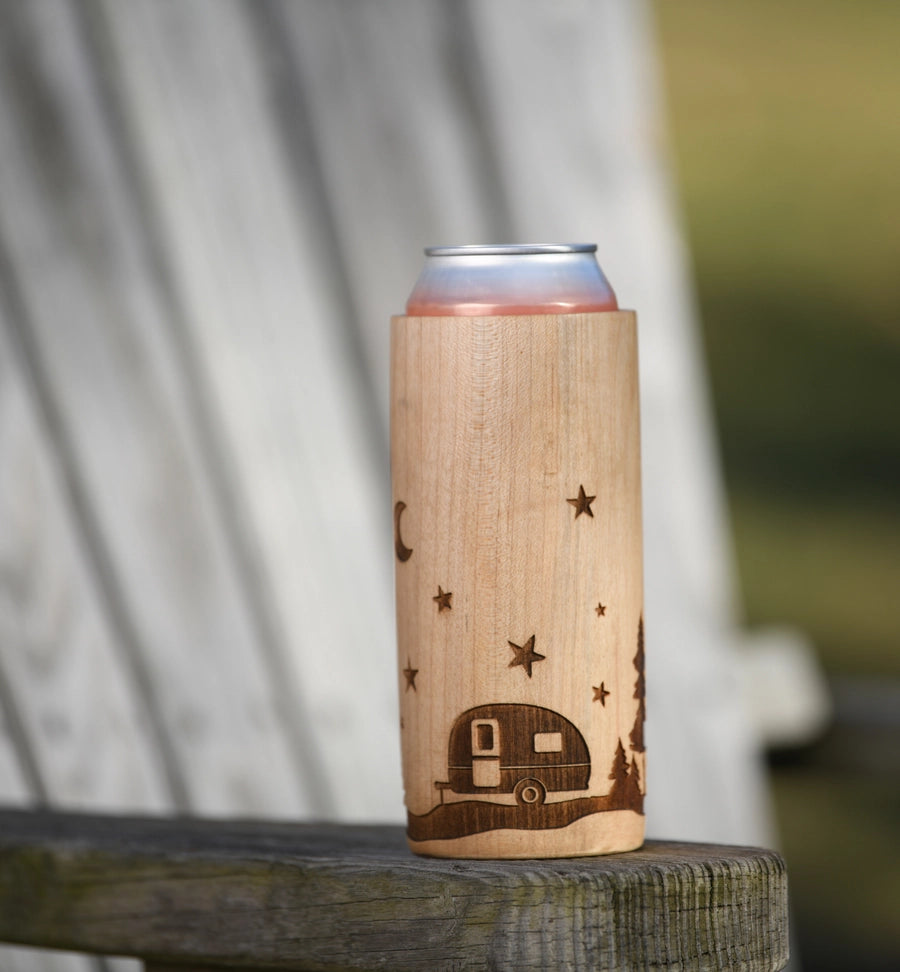
The TreeSleeve from Better Wheel VT is not a koozie with a sustainability story bolted on. It is built from a fundamentally different material, with fundamentally different end-of-life behavior, and it looks nothing like the printed foam cylinders that have dominated the market for decades.
Material Honesty
Neoprene and foam are petroleum-derived. Most fabric koozies are polyester blends that shed microplastics when washed. The TreeSleeve is crafted from sustainably sourced Vermont hardwood, which means when it reaches the end of its useful life, it returns to the earth without leaving a chemical residue. That is not a marketing angle. That is basic material science.
Wood also has natural thermal resistance. Hardwoods like maple and birch have cell structures that resist heat transfer, which is exactly what you want when you are trying to keep a can cold on a hot July afternoon. The insulating effect is genuine, not just aesthetic.

Design That Tells a Story
Better Wheel VT offers designs featuring Vermont wildlife motifs, outdoor themes like mountain ridgelines and forest scenes, and fully custom options. This is not the same as slapping a logo on a neoprene sleeve. The engraving on a hardwood can sleeve carries the texture, the grain, and the warmth of a material that has an actual connection to the natural world the design is celebrating.
Pro tip: If you are buying a wooden can sleeve as a gift for a hiker or backpacker, choose a design that reflects a specific place they love, such as a mountain outline or a local wildlife species. Specificity transforms a functional gift into a personal one.
Sustainable Can Insulator vs. Alternatives
Not all can insulators are created equal, and the sustainability claims attached to many of them do not hold up under examination. The foam koozie that dominates gas station checkout lines is made from expanded polystyrene foam or neoprene, neither of which biodegrades in any meaningful human timescale. Even the more premium neoprene options marketed as eco-friendly often contain synthetic rubber compounds that persist in landfills for centuries.
Silicone can sleeves are slightly better. Silicone is more durable and does not leach chemicals the way some plastics do, but it is also not biodegradable and requires significant energy input to manufacture. The "reusable" argument only holds if the product is actually reused consistently over years, which most are not.
A wooden can sleeve from sustainably sourced Vermont hardwood sits in a different category entirely. The forestry practices behind the material matter. Vermont has some of the most rigorously managed hardwood forests in the United States, with landowners and timber operations operating under guidelines that prioritize long-term forest health. When you buy a TreeSleeve, the wood in your hand came from a forest that will still be standing, growing, and sequestering carbon for generations.
"Consumers increasingly want to know where their products come from and what happens to them at end of life. Traceability is becoming a baseline expectation, not a premium feature." - Forbes, reporting on sustainable consumer goods trends
Pro tip: When comparing eco-friendly can insulators, ask one simple question: what happens to this product in 50 years? If the answer is "it sits in a landfill," the eco-friendly label is mostly marketing.
The Biodegradable Koozie Alternative Nobody Is Talking About
The term "koozie" has become so associated with foam promotional products that most people do not even consider that a genuinely better alternative exists. The biodegradable koozie alternative space is small right now, which is exactly what makes a wooden can sleeve such a distinctive gift. You are not handing someone the same thing everyone else received at the company picnic.
In practice, the difference in how a wooden can sleeve is received versus a standard koozie is dramatic. People who receive a TreeSleeve pick it up, turn it over, run their fingers along the grain, and ask where it came from. That tactile engagement is something no foam product can replicate. It creates a conversation, and that conversation almost always circles back to the values behind the product: sustainability, Vermont craftsmanship, and a genuine respect for natural materials.
What Biodegradable Actually Means Here
Biodegradable is one of the most abused words in product marketing. For a wooden can sleeve made from natural hardwood with no synthetic coatings or chemical treatments, biodegradable means exactly what it says. Buried in soil or left in a composting environment, untreated hardwood breaks down through natural microbial processes within years, not centuries. The carbon it releases was absorbed from the atmosphere during the tree's growth, making the lifecycle roughly carbon-neutral when the forestry practices are responsibly managed.
This is a meaningful distinction from products that claim biodegradability based on technically decomposing under industrial composting conditions that most consumers never have access to.

Why Vermont Sourcing Makes This a Truly Unique Gift
Vermont has a specific identity in American culture. It is associated with clean air, maple syrup, covered bridges, craft beer, and a stubborn commitment to doing things the right way even when the cheaper option is available. A product that comes from Vermont, made from Vermont wood, carries that identity with it in a way that cannot be faked with a label.
For gift-givers looking for unique Vermont gifts, the wooden can sleeve occupies a very specific and satisfying niche. It is useful, it is beautiful, it is locally sourced, and it connects the recipient to a specific place. Compare that to a candle, a jar of jam, or a printed t-shirt, and the can sleeve wins on practically every dimension for the right recipient.
Vermont Forests and Responsible Harvesting
Vermont's forests cover roughly 78 percent of the state's land area, according to the U.S. Forest Service. The state has a long history of sustainable forestry, and its hardwood forests, dominated by sugar maple, yellow birch, and beech, are managed with attention to both ecological function and long-term timber productivity. When a company like Better Wheel VT sources from these forests, they are participating in a supply chain that has genuine environmental accountability built into it.
That story is worth telling when you give the gift. The recipient is not just getting a can sleeve. They are holding a piece of a Vermont forest that will continue to grow, filter water, sequester carbon, and support wildlife long after the can it's holding has been recycled.
Who This Gift Is Perfect For
Not every gift is for every person. A wooden can sleeve is specifically right for a few distinct profiles, and being honest about that makes the gift more meaningful, not less.
The Outdoor Adventurer Who Also Drinks Beer
This is the core audience. Someone who hikes, camps, kayaks, or mountain bikes and also appreciates a cold craft beer at the end of the day is the perfect recipient. They already value natural materials. They already care about where things come from. A wooden can sleeve fits their worldview without requiring any explanation.
The Eco-Conscious Gift Shopper Who Is Tired of Compromise
Many eco-conscious shoppers feel like they have to choose between a product that is good for the environment and a product that is genuinely high-quality and beautiful. The TreeSleeve removes that compromise. It is both, without apology, and that is rare enough to be worth celebrating.
The Craft Beer Enthusiast Who Appreciates Craft in All Forms
Someone who drinks craft beer already understands the value of process, provenance, and care in production. They are primed to appreciate a product made with the same attention to material sourcing and quality. A wooden can sleeve from Vermont hardwood speaks their language.
How Wooden Can Sleeves Compare to Other Options
Gift-givers often compare the TreeSleeve to standard koozies or other can insulators before making a decision. Here is how the options stack up across the dimensions that matter most for an eco-conscious purchase.
Feature |
TreeSleeve Wooden Can Sleeve (Better Wheel VT) |
Standard Neoprene Koozie (e.g., CoozieCooler, KoozieKing) |
Custom Printed Foam Koozie (e.g., CustomKoozies) |
|---|---|---|---|
Material Origin |
Sustainably sourced Vermont hardwood, traceable supply chain |
Petroleum-derived neoprene, synthetic rubber |
Expanded polystyrene foam or polyester fabric |
Biodegradability |
Fully biodegradable under natural conditions |
Not biodegradable, persists for centuries in landfill |
Not biodegradable, foam can break into microparticles |
Insulation Performance |
Natural thermal resistance from hardwood cell structure |
Moderate insulation, effective for short durations |
Minimal insulation, primarily decorative |
Customization Quality |
Laser-engraved designs with natural wood grain texture |
Printed graphics, can fade or peel over time |
Full-color print, but low material quality |
Gift Perception |
Premium, handcrafted, conversation-starting |
Functional but unremarkable as a gift |
Promotional, often perceived as low-value |
Ideal For |
Eco-conscious gifts, outdoor enthusiasts, craft beer lovers, Vermont gifts |
Bulk events, casual use, promotional giveaways |
Large-scale promotional events, brand merchandise |
Frequently Asked Questions
Is a wooden can sleeve actually a good insulator, or is it mostly aesthetic?
It is genuinely both. Hardwood has natural thermal insulating properties because wood cells trap air and resist heat transfer. In practice, a hardwood can sleeve keeps a cold can colder for a meaningful amount of time, particularly compared to thin neoprene alternatives. The aesthetic value is real too, but it does not come at the expense of function.
How durable is a wooden can sleeve for outdoor use like camping or festivals?
Vermont hardwoods like maple and birch are among the denser domestic wood species, which means they handle knocks, drops, and the general chaos of outdoor use without cracking or warping under normal conditions. They are not indestructible, but they are far more durable than foam alternatives and hold up well to regular outdoor use across multiple seasons.
What makes this a better eco-friendly gift for beer lovers than a reusable bottle or pint glass?
Reusable bottles and pint glasses are excellent gifts, but they serve a different use case. Many craft beer lovers and outdoor enthusiasts specifically prefer cans for portability, weight, and the fact that cans are better at blocking light and oxygen. A wooden can sleeve enhances the experience they are already choosing, rather than asking them to change their habits. It meets them where they are.
Can the designs on a TreeSleeve be customized for a specific person or occasion?
Yes. Better Wheel VT offers custom design options alongside their standard wildlife and outdoor theme collections. For gift-givers, this means you can create something tied to a specific mountain, a favorite animal, a shared memory, or an upcoming occasion. That level of personalization is what separates a thoughtful gift from a practical one, and ideally you want both.
Why is Vermont hardwood sourcing specifically meaningful from an environmental standpoint?
Vermont's forestry practices are governed by both state-level regulations and the voluntary Best Management Practices framework that most timber operations follow. The state's forests are among the most carefully managed in the country, with high rates of forest cover and active monitoring of ecological health. Sourcing from Vermont is not just a geographical claim. It is a statement about the standards applied at every stage of harvest and production.
Is a wooden can sleeve appropriate for someone who is not particularly eco-conscious?
Absolutely. The sustainability story is a compelling reason to choose it, but the gift works on its own merits even without that context. It looks handsome, it functions well, it feels substantial in the hand, and it is completely unlike anything most people already own. The eco-friendly dimension adds meaning, but it is not required for the gift to land well.
Have you given or received a wooden can sleeve as a gift? Share what made it memorable or what you would want to see in a custom design.
Share:
TreeSleeve
10 Outdoor Adventures Better With a TreeSleeve™