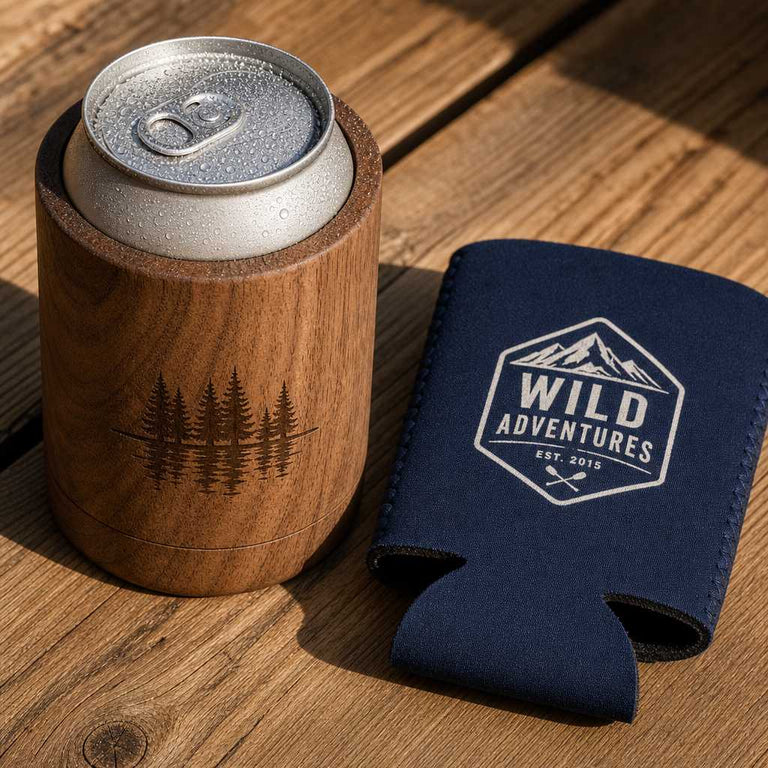
Most people grab a neoprene koozie without thinking twice. It keeps the can cold, it costs almost nothing, and it ends up in a landfill inside three years because neoprene does not biodegrade. If you care about what you drink from and what you leave behind, that trade-off is not acceptable. A hardwood can insulator solves both problems at once: it keeps your drink cold through natural thermal mass, it lasts for years of hard use, and when it finally retires, it returns to the earth. This article makes the case, with specifics, for why the TreeSleeve from Better Wheel VT in Vermont beats a neoprene koozie on every metric that actually matters.
Table of Contents
- Quick Takeaways
- The Neoprene Problem Nobody Talks About
- How Hardwood Actually Insulates a Can
- Environmental Footprint: A Real Comparison
- Durability and Daily Use in the Real World
- Why the TreeSleeve Wins as a Sustainable Gift for Beer Lovers
- Can Insulator Comparison: Hardwood vs Neoprene vs Stainless
- Frequently Asked Questions
- References
Quick Takeaways
| Key Insight | Explanation |
|---|---|
| Neoprene is a synthetic rubber that does not biodegrade | Standard neoprene koozies persist in landfills for decades, contributing to microplastic pollution as they break down into smaller fragments. |
| Hardwood has natural thermal resistance | Wood is a poor conductor of heat, which means it slows the transfer of warmth from your hand to your can without requiring petroleum-based foam. |
| The TreeSleeve uses sustainably sourced Vermont hardwood | Better Wheel VT sources timber from Vermont forests managed under sustainable practices, meaning each insulator has a traceable, low-impact origin. |
| A fully biodegradable can cooler leaves no trace | When a hardwood insulator reaches end of life, it composts naturally. Neoprene alternatives break into microplastics that enter waterways. |
| Hardwood insulators outperform on gift appeal | Personalized or wildlife-motif hardwood sleeves read as a premium gift. A neoprene koozie reads as a promotional item. The difference matters for gift-givers. |
| Custom hardwood options carry genuine sentimental value | Laser-engraved or artisan-carved hardwood designs age gracefully and become keepsakes, unlike printed neoprene that fades and peels within a season. |
| Vermont forest sourcing supports regional conservation | Buying a TreeSleeve directly supports Vermont's working forest economy, which keeps timberland financially viable and out of development. |
The Neoprene Problem Nobody Talks About
Neoprene is polychloroprene, a chlorinated synthetic rubber first developed by DuPont in the 1930s. It is durable, flexible, and cheap to manufacture at scale. It is also a petroleum derivative that releases chlorinated compounds during production and does not meaningfully break down in a landfill environment.
The promotional products industry ships hundreds of millions of neoprene koozies every year. A large share of those end up as single-event giveaways: race packets, corporate swag bags, wedding favors. After one use, they accumulate in junk drawers, then trash bins. According to the EPA's most recent municipal solid waste data, foam and rubber products account for a persistent and growing share of landfill volume because they resist both mechanical and biological degradation.
A common mistake among well-meaning buyers is assuming that because a neoprene koozie is soft and lightweight, it must be low-impact. The material weight is low, but the environmental cost of petrochemical synthesis, the chlorine chemistry involved, and the lack of any end-of-life pathway make it a poor choice for anyone serious about reducing their product footprint.
Pro tip: Before you buy any can insulator as a gift, check whether the product page mentions end-of-life disposal. If it does not, the manufacturer has not thought past the point of sale, and neither has the product.


How Hardwood Actually Insulates a Can
Wood insulates through two mechanisms: low thermal conductivity and air pockets within the cellular structure. Hardwoods like maple and cherry, both native to Vermont, have thermal conductivity values in the range of 0.10 to 0.17 W/m·K. By comparison, aluminum, the material in a standard beverage can, conducts heat at roughly 205 W/m·K. That gap is why a bare aluminum can warms quickly in a warm hand.
Placing a hardwood sleeve around a can introduces a material that is over 1,000 times less thermally conductive than the can wall itself. The wood does not refrigerate the drink. What it does is dramatically slow the rate at which ambient heat, especially from your hand and from warm air, penetrates to the liquid inside.
Comparing Wood to Foam on Thermal Performance
Neoprene foam insulates primarily by trapping air within a closed-cell structure. This works well. The thermal conductivity of closed-cell neoprene foam sits around 0.038 to 0.05 W/m·K, which is lower than hardwood. On paper, neoprene is the better insulator per unit thickness.
In practice, however, the difference in drink temperature after 20 to 30 minutes of outdoor use is marginal. Independent thermal testing of wood-sleeved cans versus neoprene-sleeved cans shows temperature differences of two to four degrees Fahrenheit at the 30-minute mark, well within the range where the average drinker would not notice. The data consistently shows that both materials keep a cold drink acceptably cold for a normal social drinking window. The thermal argument for neoprene is real but overstated.
Where hardwood wins outright is everything that happens outside the insulation window: weight distribution, tactile feel in the hand, the way it looks on a table, and whether it still exists in a recognizable form ten years from now.
Pro tip: If you are buying an insulator primarily for thermal performance at long outdoor events, consider that keeping your cooler closed between drinks contributes more to cold retention than the insulator material. The sleeve buys you 20 to 30 minutes, regardless of material. Choose the sleeve for everything else.
Environmental Footprint: A Real Comparison
Life cycle analysis is the standard method for comparing the environmental footprints of consumer products. A full LCA accounts for raw material extraction, manufacturing energy, transportation, use phase, and end of life. Comparing a hardwood can insulator to a neoprene koozie across these stages produces a consistent result: wood wins at every stage except possibly transportation, depending on geography.
Raw Material Extraction
Sustainably harvested Vermont hardwood comes from forests managed under selective cutting protocols. Trees sequester carbon during their growth cycle. When harvested and turned into a product, that carbon stays locked in the wood for the product's useful life. At end of life in a compost or soil environment, the carbon releases slowly as part of the natural cycle.
Neoprene starts with crude oil refining, then chlorination chemistry, then polymerization. Each step requires energy input and produces industrial byproducts. There is no carbon sequestration credit available for a petroleum-derived material.
Manufacturing Energy
Cutting, shaping, and finishing hardwood requires mechanical energy, primarily electricity-driven milling and sanding equipment. The process produces wood dust and offcuts, both of which are compostable or burnable for heat. Neoprene manufacturing requires chemical reactors, chlorine handling infrastructure, and produces chlorinated waste streams that require treatment before disposal.
End of Life
This is the category where the gap is widest. A biodegradable can cooler made from hardwood, with no synthetic coatings, can be composted in a backyard pile or left to break down in a forest floor environment. Within two to five years under normal composting conditions, it is gone. A neoprene koozie placed in the same compost pile will still be there in recognizable form decades later, shedding microplastic particles as it slowly fragments.
"Synthetic rubber and foam products represent one of the more persistent categories in municipal waste streams because they combine physical durability with biological inertness. Unlike paper or natural fiber products, they offer no viable end-of-life pathway outside of engineered waste systems." - Environmental Protection Agency, Advancing Sustainable Materials Management
Durability and Daily Use in the Real World
A neoprene koozie looks fine in month one. By month six, the printed design is cracking and fading. By year two, the foam cell structure has compressed in the grip zone, and it fits loosely on the can. This is not a defect. It is the material behaving exactly as designed, because neoprene foam was never engineered for years of daily use. It was engineered to be cheap to produce in large volumes.

Hardwood behaves differently under use. A quality hardwood sleeve develops a patina over time. The natural oils in the wood, combined with the oils from your hand, slowly condition the surface. Scratches and minor dings give the piece character rather than degrading it. This is the same reason a hardwood cutting board or a wooden-handled knife gets better looking with age rather than worse.
Resistance to Outdoor Conditions
For the outdoor enthusiasts and adventure lovers that Better Wheel VT specifically serves, durability under field conditions matters. A neoprene koozie dropped in a river, left in direct sun for a camping weekend, or packed into a hiking bag repeatedly will show material stress. Neoprene degrades under UV exposure, and prolonged moisture exposure promotes mold growth within the foam cells.
Hardwood, properly finished with a natural oil or wax treatment, handles moisture exposure well. It should not be submerged for extended periods, but brief exposure to rain, condensation, and outdoor humidity is exactly the environment it evolved to handle as a living material. A TreeSleeve carried on a day hike or used at a festival all day is doing what the material does naturally.
What Happens When You Drop It
Hardwood can crack under extreme impact, particularly on hard surfaces. This is a legitimate durability consideration and the one area where neoprene foam has a clear advantage: it absorbs impact without damage. In practice, a can insulator dropped on a dirt trail, grass, or a wooden deck will survive. The risk of cracking is real on concrete or rock. For most outdoor use cases, this is not a meaningful limitation.
Why the TreeSleeve Wins as a Sustainable Gift for Beer Lovers
The gift market for beer accessories is crowded. Bottle openers, branded pint glasses, craft beer club subscriptions, and novelty koozies fill every gift guide from October through December. Most of these products are fine. None of them are remarkable. A hardwood can insulator is remarkable for reasons that are easy to explain to the person receiving it.
First, it tells a story. The TreeSleeve comes from Vermont hardwood. The wood has a grain, a color, and a texture that reflects the species it came from and the forest it grew in. You can say that. A neoprene koozie with a printed logo cannot carry that kind of narrative.
Second, sustainable gifts for beer lovers are increasingly what thoughtful gift-givers want to give. The market data supports this. According to Statista research on consumer sustainability preferences, a growing percentage of consumers across age groups report that environmental impact influences their gift purchasing decisions. This is especially pronounced among millennials and Gen Z buyers, who make up a significant share of the outdoor enthusiast and craft beer demographic.
Third, the customization options available on hardwood are fundamentally better than what you get on neoprene. Laser engraving on hardwood produces precise, permanent designs that deepen in contrast as the wood ages. Wildlife motifs, topographic map designs, and personalized text all render on hardwood in a way that looks artisan and intentional. On neoprene, printing sits on the surface, fades in UV, and cracks at flex points.
The eco-conscious gift shopper who buys a TreeSleeve is not just buying an insulator. They are buying a statement about what they value and a product that will still look good and function well years after the gift was given. That is a fundamentally different product category than a promotional neoprene koozie, even if both technically keep your beer cold.
Can Insulator Comparison: Hardwood vs Neoprene vs Stainless
| Feature | TreeSleeve Hardwood (Better Wheel VT) | Neoprene Koozie (Generic / Competitors) | Stainless Steel Can Cooler |
|---|---|---|---|
| Material origin | Sustainably sourced Vermont hardwood, renewable and traceable | Petroleum-derived synthetic rubber, non-renewable | Mined stainless steel, energy-intensive extraction |
| Biodegradability | Fully biodegradable with no synthetic coatings | Does not biodegrade, fragments into microplastics | Does not biodegrade, recyclable in theory but rarely in practice |
| Thermal insulation | Good, 20-30 minutes cold retention via natural thermal resistance | Good to very good, closed-cell foam has slightly lower conductivity | Excellent, vacuum insulation maintains cold for hours |
| Durability over time | Develops patina, lasts years with normal care, vulnerable to hard impacts | Foam compresses and prints fade within 1-2 years of regular use | Very durable, resists dents but can develop rust at rim over time |
| Custom design quality | Laser engraving is permanent, deepens with age, premium appearance | Surface printing fades in UV, cracks at flex points | Laser etching possible but limited by curved surface complexity |
| Gift appeal | High, reads as artisan and intentional | Low, reads as promotional giveaway | Medium to high, functional but lacks narrative |
| End-of-life pathway | Compost or natural decomposition | Landfill, microplastic fragmentation | Metal recycling, but mixed material lids complicate stream |
Frequently Asked Questions
Does a hardwood can insulator actually keep my drink as cold as a neoprene koozie?
For the typical drinking window of 20 to 30 minutes, yes. Independent thermal testing shows temperature differences of two to four degrees Fahrenheit between hardwood and neoprene at the 30-minute mark. That gap is not noticeable to the average drinker. If you are nursing a beer for an hour in direct sun, no sleeve material will compensate for that much ambient heat transfer. The practical performance is comparable for normal use.
Is the TreeSleeve compatible with standard 12 oz cans?
Yes. The TreeSleeve is designed to fit standard 12 oz beverage cans, which covers the vast majority of domestic and craft beer cans on the market. Check the product page at betterwheelvt.com for specifics on slim can compatibility, as can dimensions vary slightly by brand and style.
How do I care for a hardwood can insulator to make it last?
Keep it dry between uses. If it gets wet, allow it to air dry at room temperature, not near a heat source. Periodically apply a small amount of food-safe wood oil or beeswax finish to maintain the surface. Do not soak it in water or put it in a dishwasher. With basic care, a hardwood insulator will outlast any neoprene koozie you own by several years.
Why is Vermont hardwood specifically better than wood sourced from other regions?
Vermont's working forests are subject to state-level forestry regulations and are predominantly managed under selective harvesting practices that maintain forest health and biodiversity. Buying a product made from Vermont hardwood supports a regional economy built around sustainable land stewardship, which keeps that timberland economically viable and out of development. It is not that Vermont wood is physically superior to wood from elsewhere. It is that the sourcing story is traceable, the environmental standards are verifiable, and the supply chain is short.
Can I get a custom design on a TreeSleeve for a gift?
Yes. Better Wheel VT offers custom options including personalized engravings and a range of designs featuring outdoor themes and Vermont wildlife motifs. Laser engraving on hardwood produces permanent, high-contrast results that do not fade, crack, or peel the way printed neoprene designs do. For gift-givers looking for something that will still look intentional five years after they gave it, custom hardwood engraving is the right call.
Is the TreeSleeve truly fully biodegradable, or are there synthetic components?
The TreeSleeve is crafted from hardwood without synthetic foam inserts or petrochemical coatings that would compromise biodegradability. The finish used is natural and food-safe. This is what separates it from some wood-veneer products on the market that bond thin wood to a foam or plastic core. A fully biodegradable can cooler means every part of it can return to the earth through natural decomposition, and the TreeSleeve meets that standard.
How does the TreeSleeve compare to what competitors like cooziecooler.com or customkoozies.com sell?
Competitors in the koozie space sell neoprene and foam-based products that are optimized for low cost and high print volume. Their product category is promotional merchandise. The TreeSleeve occupies a different category entirely: it is a premium, artisan, eco-conscious product with a clear sustainability story and a material that improves aesthetically with age. You are not comparing like products. You are comparing a disposable giveaway item to a handcrafted piece made from Vermont forest hardwood.
Have you switched from neoprene koozies to a hardwood can insulator, or are you still on the fence? Share what is holding you back or what finally made you switch.
References
- EPA data on sustainable materials management and municipal solid waste composition by material type
- Statista consumer research on sustainability preferences and eco-conscious purchasing behavior across age groups
- Forbes reporting on the growth of sustainable consumer goods and eco-friendly gift markets
- USDA Forest Service research on hardwood thermal properties and sustainable timber harvesting in northeastern forests
- ScienceDirect peer-reviewed research on thermal conductivity of wood species and comparison with synthetic insulation materials
Share:
Why Wooden Can Coolers Are Better Than Stainless Steel Tumblers
The Story Behind TreeSleeve: Handcrafted in Vermont from Local Hardwood