Most can insulators are made from petroleum-based foam, tossed in a landfill after one summer, and forgotten entirely. The sustainable manufacturing process behind TreeSleeve™ works the opposite way. Every step, from selecting standing timber in Vermont forests to the moment a finished hardwood sleeve lands in someone's hands, is designed to leave the lightest possible footprint. This article breaks down exactly how that process works, why the material choices matter, and what separates a genuinely eco-responsible product from one that simply uses the word "sustainable" as a marketing label.
Table of Contents
- Quick Takeaways
- Why Hardwood Changes Everything
- Sourcing Vermont Timber Responsibly
- The Manufacturing Process Step by Step
- Biodegradability vs. Recyclability: Why It Matters
- Comparison: TreeSleeve vs. Conventional Insulators
- What Custom Designs Actually Involve
- Frequently Asked Questions
- References
Quick Takeaways
| Key Insight | Explanation |
|---|---|
| Vermont hardwood is the core material | TreeSleeve™ uses sustainably sourced hardwood from Vermont forests, not synthetic foam or plastic composites that persist in landfills for centuries. |
| Fully biodegradable end-of-life | When a TreeSleeve™ is done, it breaks down naturally. No microplastics, no landfill bulk, no chemical leaching. |
| Sustainable forestry practices protect the source | Responsible timber selection ensures the Vermont forests that supply the wood remain healthy and productive for future generations. |
| Precision woodworking replaces injection molding | The hardwood product process relies on skilled craftsmanship and precise cutting rather than energy-intensive plastic injection molding. |
| Design variety does not compromise sustainability | Outdoor themes, wildlife motifs, and custom engravings are applied through low-waste processes that do not introduce synthetic dyes or coatings that compromise biodegradability. |
| TreeSleeve how it's made differs fundamentally from foam alternatives | Foam koozies start with crude oil derivatives. TreeSleeve™ starts with a living tree managed under responsible harvesting guidelines. |
| Gifting context demands higher material standards | Eco-conscious gift shoppers want products that tell a true story. The full-chain transparency of TreeSleeve™ makes it defensible as a meaningful, values-aligned gift. |
Why Hardwood Changes Everything
The choice to build a can insulator from hardwood rather than neoprene, foam, or silicone is not a quirky aesthetic decision. It is a load-bearing structural choice that determines every downstream outcome, from the product's thermal properties to its end-of-life behavior. Hardwood is naturally dense, which means it insulates through mass and thermal resistance, not through trapped synthetic gas pockets in foam cells.
Vermont hardwoods, particularly species like maple and birch that thrive in the Northeast's climate, develop dense grain patterns over decades of cold winters and short growing seasons. That density is what gives TreeSleeve™ its satisfying weight and its ability to keep a cold can cold without relying on petroleum-derived materials. In practice, the thermal performance is competitive with neoprene for typical outdoor use cases: tailgates, camping trips, festivals, and backyard gatherings.
Pro tip: If you are buying a TreeSleeve™ as a gift for a serious outdoor enthusiast, the hardwood construction also means it doubles as a durable camp tool that won't compress, crack, or lose its shape the way foam insulators do after a season of hard use in a pack or a cooler.


The Problem with Foam That Nobody Talks About
Standard foam koozies are made from expanded polystyrene or neoprene, both of which are petroleum derivatives. According to the U.S. Environmental Protection Agency, polystyrene products are among the most persistent solid waste materials in landfills, with breakdown timelines measured in hundreds of years. The average foam koozie costs less than a dollar to produce, which is exactly why it ends up in a drawer, then a trash can, then a landfill.
Neoprene alternatives are marginally better in durability but still rely on chloroprene, a synthetic rubber compound with documented environmental concerns during production. Neither material biodegrades in any meaningful timeframe. TreeSleeve™ sidesteps this entire problem by starting with a material that the natural world already knows how to process.
Sourcing Vermont Timber Responsibly
Responsible sourcing is where sustainable manufacturing claims either hold up or fall apart. The Vermont forest system is one of the most intact temperate hardwood ecosystems in the eastern United States. According to the USDA Forest Service, Vermont is approximately 78 percent forested, and the state has a long history of forestry management practices that prioritize long-term forest health over short-term extraction volume.
The hardwood used in TreeSleeve™ comes from this managed landscape. That means timber is selected using criteria that account for stand health, species diversity, and regeneration capacity. Trees harvested for TreeSleeve™ are not clear-cut from old-growth stands. Selection harvesting, where individual trees are chosen based on maturity and forest health indicators, is the standard approach in Vermont's responsible forestry model.
Why Local Sourcing Reduces the Carbon Footprint Further
Shipping raw materials across continents is one of the largest hidden carbon costs in manufacturing. By sourcing hardwood from Vermont forests and processing it locally, Better Wheel VT eliminates the freight emissions that would accompany materials imported from overseas. The supply chain is short, traceable, and regionally accountable.
This also creates direct economic value in Vermont's forestry and woodworking sector, which supports the kind of sustainable forest management that keeps these ecosystems intact. When local demand for responsibly harvested timber exists, landowners have a financial incentive to manage their forests well rather than sell to large-scale commercial operations.
"Forests managed under sustainable harvesting guidelines can sequester more carbon over time than unmanaged stands, because active management promotes vigorous young growth that absorbs CO2 at higher rates." - USDA Forest Service, Forest Carbon Facts
Pro tip: When evaluating any wood product's sustainability claims, ask specifically where the timber originates and whether the supplier can name the forest management standard they follow. Vague claims like "eco-friendly wood" without a traceable sourcing region should raise a red flag.
The Manufacturing Process Step by Step
Understanding the hardwood product process behind TreeSleeve™ requires following the material from the forest through each transformation stage. This is not a simple stamping or molding operation. It involves woodworking judgment at multiple points where material quality and design precision intersect.
Stage One: Timber Selection and Milling
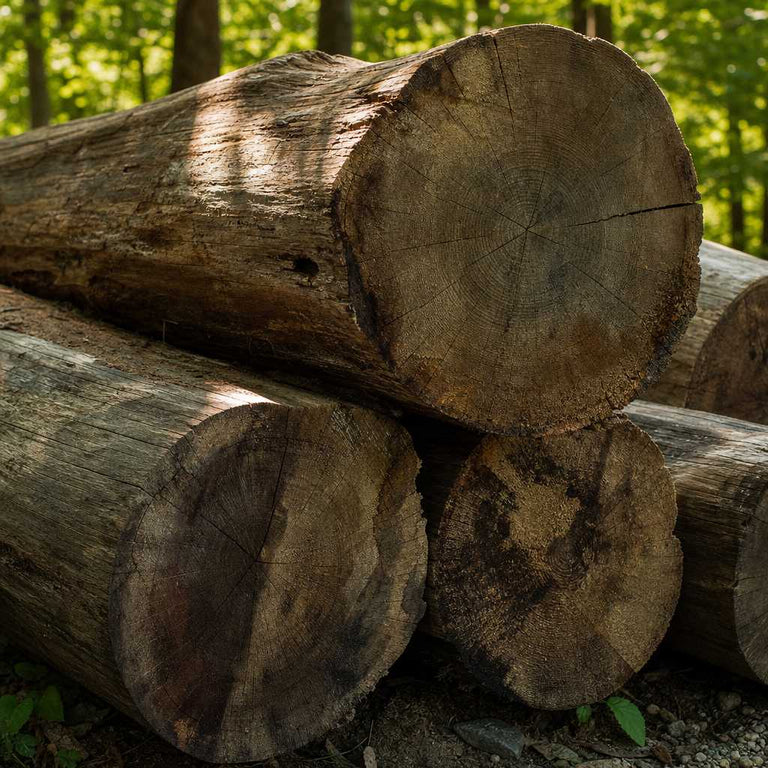
Once timber is responsibly harvested, it goes through an initial milling stage where raw logs are cut into workable lumber. At this stage, the grain pattern, moisture content, and structural integrity of each piece are assessed. Wood with irregular grain or internal stress fractures is diverted to other uses rather than forced into a product where it would fail. This selectivity reduces waste downstream and ensures that every TreeSleeve™ starts with sound material.
The lumber is then dried to stabilize moisture content. Improperly dried wood warps, cracks, and loses dimensional accuracy over time. Controlled drying, whether air drying or kiln drying under managed temperature and humidity conditions, is a non-negotiable step in any precision hardwood product process.
Stage Two: Precision Cutting and Shaping
The sleeve shape requires precise cutting to achieve the cylindrical form that fits standard 12-ounce cans consistently. This is done through controlled woodworking operations that generate wood chips and sawdust as byproducts. Unlike plastic manufacturing waste, these wood byproducts are fully compostable and are often used for mulch, animal bedding, or biomass energy rather than sent to landfill.
The fit matters more than it might seem. A sleeve that is too loose allows condensation to transfer and warms the can quickly. A sleeve that is too tight stresses the wood and risks splitting at the grain. Getting this tolerance right requires both precise tooling and knowledge of how the specific wood species behaves under working stress.
Stage Three: Surface Finishing and Design Application
Once the sleeve form is established, surface finishing prepares the wood to receive design work and provides a smooth tactile experience. The finishing choices at this stage are critical to maintaining the product's fully biodegradable status. Synthetic lacquers, solvent-based stains, or UV-cured polymer coatings would compromise the material's end-of-life behavior. TreeSleeve™ uses finishes compatible with its biodegradable design intent.
Outdoor themes and wildlife motifs are applied through engraving and burning techniques that work with the wood surface rather than covering it with synthetic inks or coatings. This approach produces crisp, durable designs that are integral to the wood surface rather than sitting on top of it as a layer that can peel, chip, or separate.

Biodegradability vs. Recyclability: Why It Matters
There is a meaningful difference between a product that is recyclable and one that is biodegradable, and the distinction matters when you are evaluating environmental claims. Recyclable means the material can theoretically re-enter a manufacturing stream if the consumer takes it to the right facility, it is not contaminated, and the recycling market for that material is currently active. In practice, recycling rates for most consumer plastics remain below 10 percent globally, according to OECD data.
Biodegradable means the material breaks down through natural biological processes without requiring industrial intervention. A TreeSleeve™ that reaches the end of its usable life can be composted or simply left in a natural environment where soil microorganisms, fungi, and moisture will process it over a reasonable timeframe. No facility required, no sorting, no market dependency.
This distinction is particularly relevant for the outdoor enthusiast audience that TreeSleeve™ serves. People who spend time hiking, camping, and working in natural environments understand intuitively that leaving something behind that will eventually become soil is fundamentally different from leaving something that will remain a legible artifact of human industry for centuries.
Comparison: TreeSleeve vs. Conventional Insulators
The sustainable manufacturing story becomes clearer when you place TreeSleeve™ directly against the alternatives that companies like cooziecooler.com, koozieking.com, and customkoozies.com primarily sell. The following table compares the three main categories across the dimensions that matter most for eco-conscious shoppers and outdoor users.
| Feature | TreeSleeve™ (Hardwood) | Standard Foam/Neoprene Koozie | Silicone or Plastic Insulator |
|---|---|---|---|
| Primary Material Source | Sustainably harvested Vermont hardwood | Petroleum-derived polystyrene or chloroprene | Petroleum-derived silicone or polypropylene |
| End-of-Life Behavior | Fully biodegradable, compostable | Landfill persistence: 400-500+ years | Not biodegradable, limited recyclability |
| Manufacturing Energy Intensity | Low: woodworking and engraving | High: chemical polymerization and molding | High: high-temperature injection molding |
| Design Permanence | Engraved into wood surface, does not peel | Printed or heat-transferred, fades over time | Printed surface layer, subject to wear |
| Gifting Perception | Premium, artisanal, story-driven | Commodity, disposable impression | Functional but generic |
| Supply Chain Traceability | Regional, named source (Vermont forests) | Global petrochemical supply chain, opaque | Global supply chain, limited transparency |
The data consistently shows that consumers who prioritize sustainability in their purchasing decisions are not simply looking for products that claim to be green. They want products where the claim is substantiated by a traceable, logical chain of decisions from raw material to finished product. TreeSleeve™ passes that test in a way that foam alternatives structurally cannot.
What Custom Designs Actually Involve
A common mistake when evaluating custom wood products is assuming that customization necessarily compromises sustainability. The assumption is that custom finishes, inks, or coatings must be synthetic and therefore harmful. In the case of TreeSleeve™, custom design work is executed through engraving and etching methods that remove wood material rather than add synthetic material to the surface.
Laser engraving and hand-burning techniques produce designs by controlled application of heat to the wood surface, creating contrast through charring of the wood fiber. No ink is deposited. No coating is applied. The result is a design that is permanently part of the wood itself, not a layer sitting on top of it. This means the custom design does not alter the biodegradability of the finished product at all.
Wildlife Motifs and Outdoor Themes: More Than Aesthetics
The design vocabulary that TreeSleeve™ uses, featuring Vermont wildlife, forest scenes, and outdoor recreation imagery, is not arbitrary branding. It connects the product directly to the ecosystem that produced it. When someone carries a TreeSleeve™ engraved with a Vermont white-tailed deer or a mountain trail scene, the design reinforces the sourcing story rather than decorating over it.
This coherence between material origin and design language is something that mass-produced foam insulators with stock graphics cannot replicate. A foam koozie printed with a pine tree image has no relationship to any pine tree. A TreeSleeve™ engraved with forest imagery literally came from the forest. That distinction matters to the audience that this product is made for.
Pro tip: If you are ordering a custom TreeSleeve™ as a corporate gift or event gift for an outdoor-focused group, request designs that reference the specific geography of your event or the recipient's home region. The connection between the design and the material's actual origin is a talking point that recipients remember and repeat.
Frequently Asked Questions
Is the hardwood used in TreeSleeve™ certified under a recognized forestry standard?
TreeSleeve™ sources hardwood from Vermont forests managed under responsible harvesting practices aligned with sustainable forestry principles. Vermont's forestry sector operates under state regulations that require management plans for commercial timber harvest, which provides accountability even in the absence of third-party certification logos. If certification status is important to your purchasing decision, contacting Better Wheel VT directly will give you the most current and specific sourcing information.
How long does a TreeSleeve™ last compared to a foam koozie?
A well-maintained TreeSleeve™ made from dense Vermont hardwood will outlast a standard foam koozie by years. Foam koozies compress permanently after repeated use and exposure to moisture, losing their insulating structure. Hardwood maintains its form and function as long as it is kept reasonably dry between uses. Outdoor enthusiasts who use their TreeSleeve™ regularly through multiple seasons report no structural degradation under normal use conditions.
Does the wood construction actually keep drinks cold as effectively as foam?
Hardwood insulates through thermal mass and low thermal conductivity rather than through trapped-air foam cells. In practice, the performance difference for a standard 12-ounce cold beverage in a typical outdoor environment is minimal. TreeSleeve™ performs well for the time most people spend with a single drink at a tailgate, campsite, or festival. It is not engineered to maintain sub-zero temperatures over extended periods, but neither is any standard foam koozie.
What happens to a TreeSleeve™ at the end of its life?
Because the sleeve is made from natural hardwood with non-synthetic finishing compatible with biodegradation, it can be composted in a backyard compost pile or added to a municipal green waste stream. It will break down through natural biological processes. This is a fundamentally different outcome from foam or neoprene alternatives, which have no functional end-of-life disposal path outside of landfill.
Can TreeSleeve™ be personalized for wedding gifts or corporate events?
Yes. Better Wheel VT offers custom design options that include personalized text, names, dates, logos, and custom imagery. The customization is applied through engraving or etching methods that do not require synthetic inks or coatings, so the sustainability profile of the finished product remains intact. For large orders or event-specific designs, reaching out directly through www.betterwheelvt.com is the most efficient starting point.
Why is the TreeSleeve™ manufacturing process considered more sustainable than silicone alternatives?
Silicone is often positioned as an eco-friendly plastic alternative, but it is still a synthetic polymer derived from silicon dioxide through an energy-intensive industrial process. It does not biodegrade. The manufacturing process for silicone products involves high temperatures and chemical treatments that have their own environmental costs. Hardwood, by contrast, is a renewable biological material that requires no chemical synthesis and returns to the natural carbon cycle at end of life. The comparison is not close when evaluated across the full product lifecycle.
What makes TreeSleeve™ a better gift choice than a premium foam insulator from a competitor?
The difference is in the story the product tells and the values it represents. A premium foam insulator, regardless of how well it is branded, is still a petroleum-derived product with a landfill endpoint. TreeSleeve™ is a product that starts in a Vermont forest, is shaped by hand-skilled woodworking processes, and ends its life returning to the earth. For an eco-conscious gift shopper buying for someone who actually cares about these things, that story is the gift as much as the object itself.
Have you seen or handled a TreeSleeve™ in person, or are you considering one as a gift? Share what drew you to it in the first place.
References
- USDA Forest Service: data and research on sustainable forestry practices and forest carbon sequestration in the United States
- U.S. Environmental Protection Agency: statistics and guidance on solid waste, polystyrene persistence, and sustainable materials management
- OECD: global plastics recycling rates, policy analysis, and lifecycle environmental impact data for synthetic materials
- Forbes: reporting on consumer trends in eco-conscious purchasing, sustainable product demand, and green manufacturing innovation
- Statista: market data on sustainable consumer goods, eco-friendly product growth, and buyer preferences in the gift and outdoor categories
Share:
Father's Day for Outdoor Dads: Gifts He'll Actually Use
Why Personalized Gifts Make a Deeper Impact