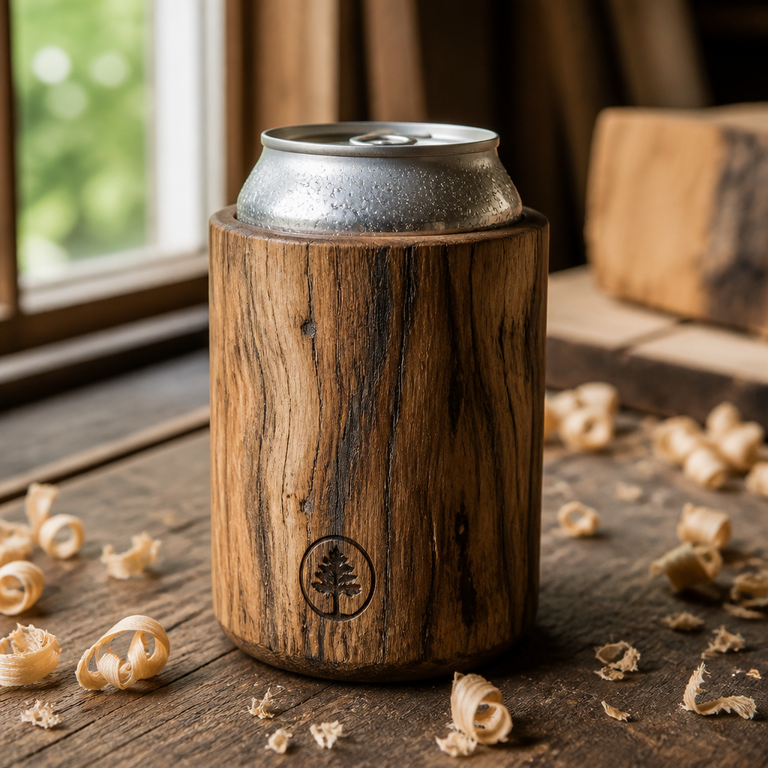
Most can insulators are made from neoprene foam, manufactured overseas, and headed for a landfill within months. TreeSleeve™ takes the opposite approach. Better Wheel VT crafts each insulator from sustainably sourced Vermont hardwood, turning a throwaway product category into something that actually belongs in nature. This article tells the full story behind TreeSleeve™, from the forests of Vermont to the campfire ring, and explains why the materials, the mission, and the craftsmanship matter more than most people realize when choosing a can insulator that reflects what they actually value.
Table of Contents
- Quick Takeaways
- Why Vermont Hardwood Products Stand Apart
- The TreeSleeve Story: How It Started
- Sustainably Sourced Wood: What It Actually Means
- How TreeSleeve Is Made, From Forest to Finished Product
- TreeSleeve vs. Neoprene vs. Stainless: An Honest Comparison
- What It Actually Means to Be an Eco-Friendly Vermont Brand
- Who TreeSleeve Is Really For
- Frequently Asked Questions
- References
Quick Takeaways
Key Insight |
Explanation |
|---|---|
TreeSleeve™ is fully biodegradable |
Unlike neoprene or plastic insulators, TreeSleeve™ breaks down naturally at end of life, leaving no persistent waste in landfills or wilderness areas. |
Vermont hardwood is the core material |
Hardwoods like maple and birch from Vermont forests provide natural insulation properties and structural integrity that synthetic materials cannot replicate authentically. |
Sustainable sourcing is documented, not assumed |
Better Wheel VT sources from Vermont forests managed under responsible harvesting practices, meaning no clear-cutting and active forest regeneration. |
Designs connect directly to Vermont's outdoors |
Wildlife motifs and outdoor themes are drawn from actual Vermont landscapes, giving gift recipients something regionally specific rather than generic nature art. |
Custom options make it a standout gift |
TreeSleeve™ can be customized for individuals, events, or brands, making it relevant for festivals, weddings, corporate gifts, and outdoor gatherings. |
Hardcrafted production means limited batch sizing |
Because each piece is crafted from real wood rather than mass-produced from foam molds, quantity limitations are real. Ordering early matters for events and holidays. |
The product targets values, not just function |
TreeSleeve™ buyers are not just keeping their beer cold. They are making a statement about what they care about, which is why the story behind the product matters as much as the product itself. |
Why Vermont Hardwood Products Stand Apart
Vermont has one of the highest forest coverage rates in the United States. According to the USDA Forest Service, roughly 78 percent of Vermont's total land area is forested, which means the state's identity and its timber resources are genuinely intertwined. That is not marketing language. It is geography.
When a company like Better Wheel VT says its products come from Vermont forests, it is making a claim that can be walked back to a specific landscape, a specific ecology, and a specific timber culture that has been part of the region for generations. That specificity is what separates Vermont hardwood products from generic "natural wood" items made from unspecified sources.
What Makes Vermont Hardwood Different From Generic Wood Products
Vermont hardwoods, particularly sugar maple, yellow birch, and white ash, grow slowly in the cold northeastern climate. Slower growth means denser grain, which translates directly into durability and a finished surface quality that tropical or plantation-grown softwoods cannot match.
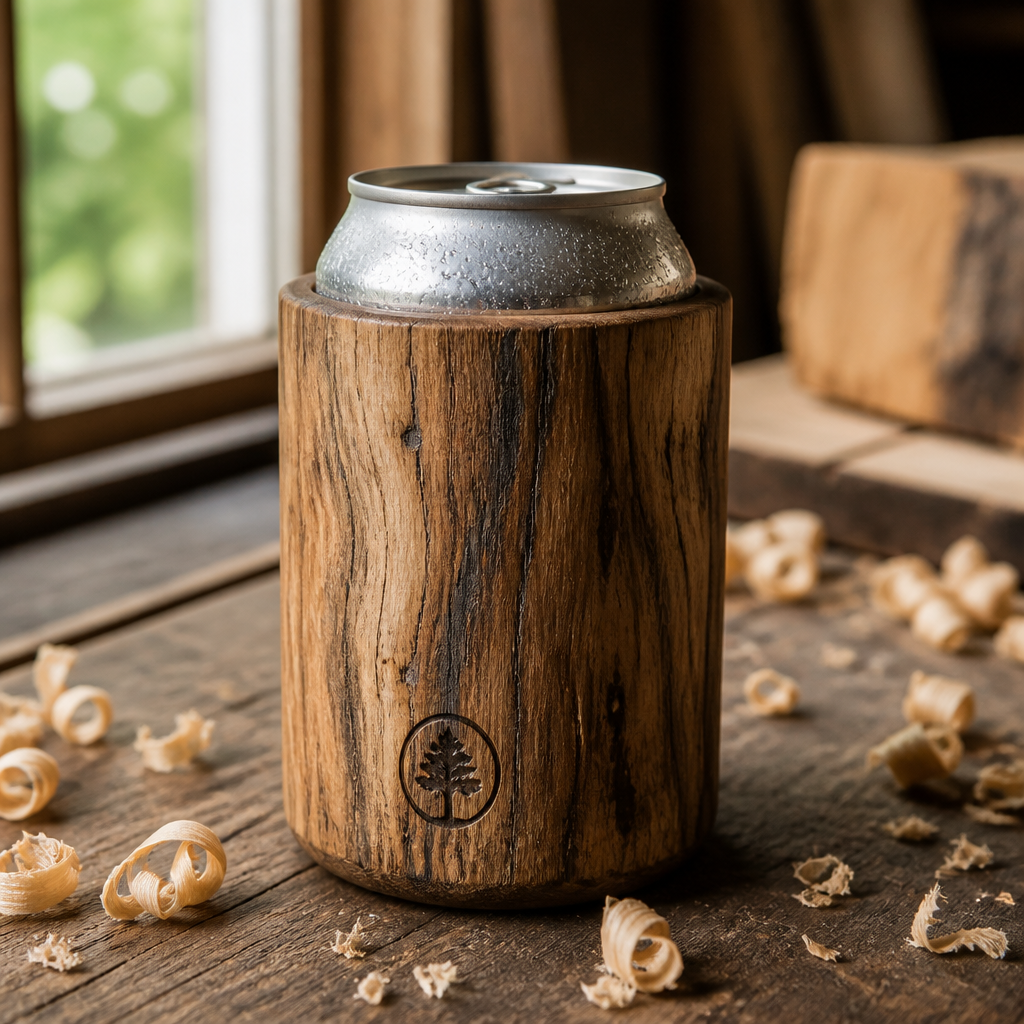
In practice, this matters for a can insulator in two specific ways. First, the density of hardwood provides measurable thermal resistance, slowing heat transfer from your hand and the surrounding air into the can. Second, the tight grain accepts engraving and surface treatments with a level of detail that looser-grained wood simply cannot hold. The wildlife motifs and outdoor designs on TreeSleeve™ insulators are as sharp as they are because the material itself demands precision.
Pro tip: If you are shopping for a wooden can insulator and a brand cannot tell you the specific wood species or region of origin, that is a signal the material sourcing is not something they have thought carefully about. Specificity is a marker of quality and accountability.

The TreeSleeve Story: How It Started
Better Wheel VT did not set out to compete with foam koozie brands. The company started from a specific frustration: the gap between what outdoor enthusiasts and eco-conscious consumers actually value and what the market was offering them. Neoprene foam printed with a logo is not a gift. It is an afterthought.
The TreeSleeve story begins with Vermont itself. The founders saw a region with world-class hardwood resources, a strong tradition of craftwork, and a population of outdoor-oriented people who genuinely care about where their products come from. The question was whether those three things could be combined into something people would actually use around a campfire, at a music festival, or on a kayak trip.
The Problem TreeSleeve™ Was Built to Solve
Standard can insulators fail on multiple fronts for this specific audience. They are made from petroleum-based materials, manufactured offshore, designed to be disposable, and carry no meaningful story or connection to place. For someone who packs out their trash on a trail and buys local produce, handing a friend a neoprene koozie as a gift creates cognitive dissonance.
TreeSleeve™ was built to eliminate that dissonance. Every element of the product, the material, the sourcing, the craftsmanship, and the design, is deliberately aligned with the values of its intended buyer. That alignment is not accidental. It was the founding design principle.
"Consumers increasingly want to know the story behind what they buy. Products with a clear provenance and a transparent supply chain earn trust that marketing alone cannot manufacture." - McKinsey and Company, on consumer trust and product transparency
Sustainably Sourced Wood: What It Actually Means
The phrase "sustainably sourced" has been diluted by overuse. It appears on products ranging from legitimately certified timber to wood of entirely unknown origin. For someone buying a TreeSleeve™ insulator as a gift for an eco-conscious friend, it is worth understanding what sustainably sourced wood actually requires in practice.
Responsible Harvesting in Vermont's Forest Context
Responsible timber harvesting means the rate of extraction does not exceed the rate of natural regeneration. In Vermont, the state's Current Use Program and Act 250 land use regulations create a legal and financial framework that incentivizes landowners to manage forests for long-term health rather than short-term extraction. This is not just an ethical preference. It is backed by policy.
Better Wheel VT sources from forests operating within this framework, meaning the hardwood in your TreeSleeve™ comes from a working landscape designed to produce timber indefinitely without degrading the ecosystem. The trees harvested are selected individually or by small group, not clear-cut. The forest canopy and soil structure remain intact.
Why Biodegradability Matters Beyond the Buzzword
A product that is biodegradable is not automatically good for the environment. The question is what it biodegrades into and how long that takes. Wood from hardwood trees decomposes through natural fungal and microbial processes into organic matter that feeds soil rather than contaminating it. Neoprene foam does not biodegrade meaningfully within human timescales.
According to data from the U.S. Environmental Protection Agency, plastic and rubber products make up a significant share of durable goods landfill waste, and their persistence in the environment is measured in centuries. A hardwood can insulator that lasts a decade of use and then composts within a few years in a backyard pile is not a compromise. It is the right answer.
Pro tip: When evaluating any product marketed as eco-friendly, ask two questions: what is the material at end of life, and what happens to it in a realistic disposal scenario? If the answer to the second question is "landfill," the first question does not matter as much as the brand wants you to think.
How TreeSleeve Is Made, From Forest to Finished Product
The production path for a TreeSleeve™ hardwood can insulator is short by manufacturing standards, and that is intentional. Fewer steps between raw material and finished product means fewer opportunities for quality to be diluted and fewer carbon emissions from long-distance shipping.
Milling and Material Selection
Vermont hardwood is milled to precise thickness specifications that allow the wood to flex slightly during use without cracking. This is a non-trivial engineering challenge. Hardwood at full thickness is rigid and unforgiving. The milling process creates thin-walled sections that retain structural integrity while providing the slight give that makes a can insulator comfortable to hold for extended periods.
Material selection at this stage is critical. Pieces with grain irregularities, knots in stress areas, or moisture content outside the acceptable range are rejected. This is where handcrafted production diverges from automated foam injection. A human being is making a judgment call about each piece of wood.
Engraving and Finishing
The outdoor themes and wildlife motifs on TreeSleeve™ insulators are applied using precision engraving that works with the natural grain of the wood rather than against it. The result is that no two insulators look identical even when they carry the same design, because the wood grain beneath the engraving is unique to each piece.
Finishing is applied to protect the wood surface from moisture during use without coating it in synthetic chemicals that would compromise the biodegradability of the final product. The finish is chosen specifically to be food-safe and environmentally inert, meaning your beer tastes like beer and the product stays true to its ecological commitments.
TreeSleeve vs. Neoprene vs. Stainless: An Honest Comparison
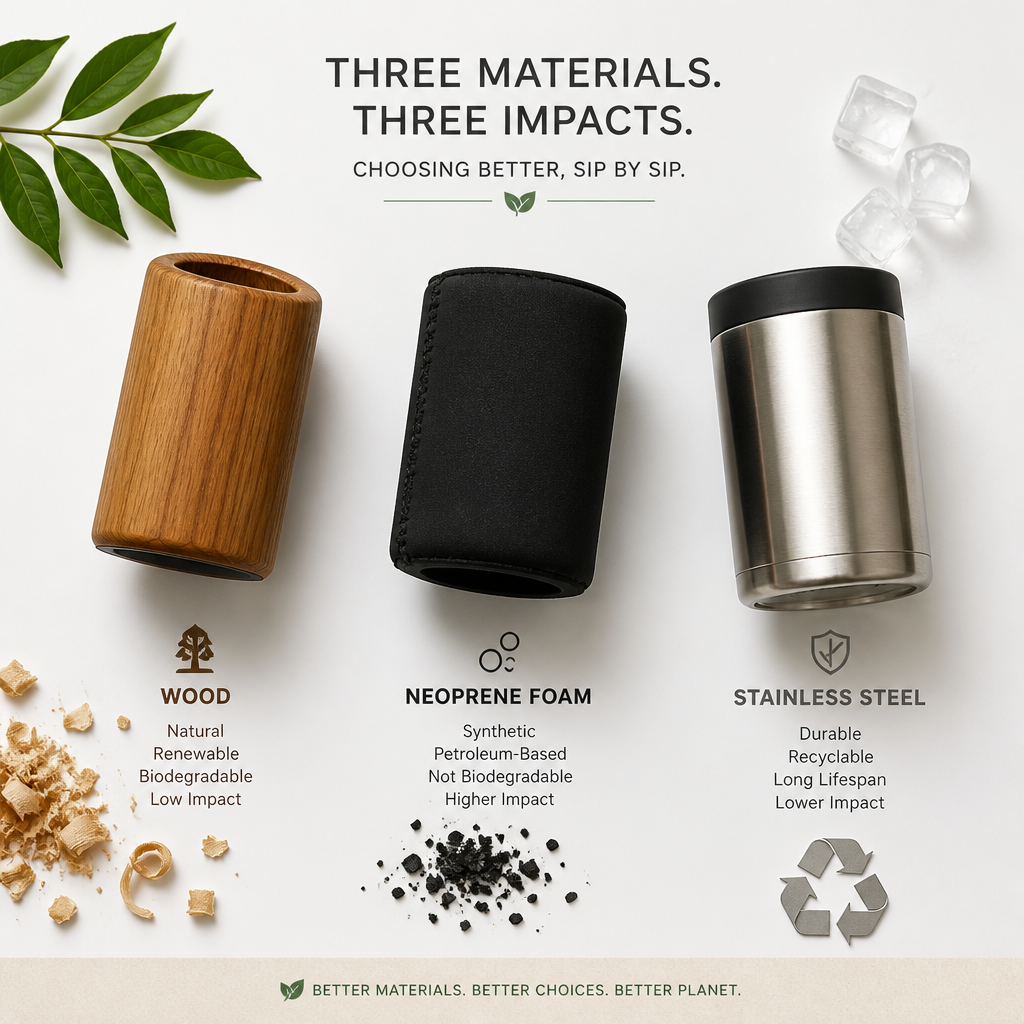
The can insulator market splits into three main material categories: neoprene foam, stainless steel, and natural materials like wood. Each has real trade-offs. This comparison is direct and does not soften the weaknesses of any option.
Feature |
TreeSleeve™ Hardwood |
Neoprene Foam (e.g., Koozie-style brands) |
Stainless Steel Sleeve |
|---|---|---|---|
Material origin |
Vermont hardwood forests, documented sustainable sourcing |
Petroleum-derived synthetic foam, typically offshore manufactured |
Mined stainless steel, energy-intensive production |
End-of-life environmental impact |
Fully biodegradable, decomposes into organic matter |
Non-biodegradable, persistent landfill waste |
Recyclable but requires industrial processing |
Insulation performance |
Good thermal resistance from wood density, adequate for typical use |
Good foam insulation, widely tested for basic cold retention |
Excellent with vacuum insulation, best cold retention |
Gift and aesthetic value |
High. Natural grain, unique designs, regional provenance. Every piece is distinct. |
Low. Generic appearance, mass-produced, no meaningful story |
Medium. Durable and sleek but lacks warmth or personality |
Customization quality |
High-detail engraving on wood grain produces sharp, lasting results |
Printed or debossed designs fade over time, especially with heat |
Laser engraving possible but cold and industrial in feel |
Best use context |
Gifts, outdoor gatherings, festivals, camping, eco-conscious buyers |
High-volume promotional giveaways where cost is the only metric |
Serious cold-weather outdoor use where performance is the priority |
The comparison is clear. TreeSleeve™ is not the right choice for someone who needs maximum cold retention at any cost or needs 500 identical items for a trade show booth. It is unambiguously the right choice for someone who wants to give a gift that reflects genuine thought, regional craft, and environmental accountability.
What It Actually Means to Be an Eco-Friendly Vermont Brand
"Eco-friendly" is a claim almost any company can make with the right copywriter. What makes it meaningful at Better Wheel VT is that the claim is load-bearing. Remove the sustainable sourcing and the product stops making sense. The entire value proposition depends on the material being what the company says it is.
Vermont has a strong tradition of small-scale manufacturing rooted in place and in environmental stewardship. According to the Vermont Agency of Agriculture, Food and Markets, the state's land-use culture has long prioritized forest health as an economic and ecological resource. Better Wheel VT operates within that tradition, not as a marketing angle but as a practical reality of doing business in a state where the landscape is both the supplier and the customer's primary motivation for caring.
Why Regional Identity Is Not Just Branding
A common mistake among small consumer goods companies is treating regional identity as a decorative layer, something to add to the packaging without it affecting the actual supply chain. Better Wheel VT inverts this. The Vermont identity is baked into the material itself. You cannot replicate a TreeSleeve™ insulator with a different wood sourced from a different region and get the same product. The place is part of what you are buying.
This matters to the target audience in a specific way. Outdoor enthusiasts and eco-conscious gift shoppers are not naive about greenwashing. They have seen enough "sustainably inspired" products to recognize when a company is performing environmentalism versus practicing it. The best signal of genuine commitment is when a brand's environmental claims constrain its business decisions, not just its marketing language.
Who TreeSleeve Is Really For
TreeSleeve™ is not a product for everyone, and Better Wheel VT is not trying to make it one. The specific audience matters, and being clear about it is more useful than a generic pitch about "nature lovers."
The Gift-Giver Who Hates Giving Generic Gifts
There is a particular kind of gift-giving frustration that TreeSleeve™ solves directly. You know the person you are buying for cares about the outdoors, drinks craft beer or cider, has opinions about where their products come from, and would find a plastic-wrapped foam koozie vaguely insulting. TreeSleeve™ is built for exactly that scenario.
The combination of Vermont origin, handcrafted production, biodegradable material, and genuinely thoughtful design gives the gift-giver something they can explain when the recipient opens it. That narrative value is real. Statista data on gifting behavior consistently shows that consumers are willing to pay a premium for gifts they can describe as meaningful or unique, particularly in the outdoor and lifestyle product categories.
The Outdoor Enthusiast Who Brings the Right Gear
For the person who thinks carefully about what goes into their pack, TreeSleeve™ fits the same logic as choosing a bamboo toothbrush or a recycled-fabric dry bag. It is a small item that signals a larger set of values. At a campsite, at a river put-in, or at an outdoor festival, pulling out a hardwood can insulator instead of a foam sleeve is a conversation starter about why material choices matter even in small everyday items.
Pro tip: For festival organizers or outdoor event planners looking for custom gifts or branded merchandise that aligns with a sustainability ethos, TreeSleeve™ custom orders offer engraved designs specific to your event. This is a sharply different option from branded foam sleeves that end up in festival garbage bins before the last set is finished.
Frequently Asked Questions
What type of Vermont hardwood is used in TreeSleeve™ insulators?
Better Wheel VT uses sustainably sourced hardwoods native to Vermont forests, including species known for dense grain and durability such as maple and birch. The specific wood used provides both the natural insulation properties and the surface quality needed for precision engraving of outdoor and wildlife designs.
Is TreeSleeve™ actually biodegradable or is that just marketing language?
It is genuinely biodegradable. Hardwood from Vermont forests decomposes through natural microbial and fungal processes into organic material that integrates back into soil. The finishing used on TreeSleeve™ is chosen specifically to remain food-safe and environmentally inert, so the decomposition process is not blocked by synthetic coatings. This is a meaningful distinction from neoprene foam, which does not biodegrade within practical timescales.
How does a hardwood can insulator compare to foam in terms of keeping drinks cold?
Dense hardwood provides measurable thermal resistance because wood is a poor conductor of heat. In practice, it performs comparably to standard neoprene foam for typical outdoor use, meaning it will keep a cold can appreciably cooler than holding it bare-handed. It does not match vacuum-insulated stainless steel for extended cold retention, but that is not the primary value proposition. TreeSleeve™ is optimized for everyday outdoor use, gift value, and environmental accountability rather than extreme cold-retention performance.
Can TreeSleeve™ insulators be customized for events or groups?
Yes. Better Wheel VT offers custom engraving options, making TreeSleeve™ a strong choice for outdoor festivals, camping retreats, weddings, corporate events, and any gathering where the host wants to give guests something genuinely memorable. Custom designs are engraved directly into the wood grain, producing results that are sharper and more durable than printed foam alternatives.
What makes Better Wheel VT different from other custom insulator brands like those selling generic foam koozies?
The material is the core difference. Companies like cooziecooler.com, koozieking.com, and customkoozies.com compete primarily on price and volume using neoprene foam. Better Wheel VT is not competing in that market. TreeSleeve™ is a handcrafted Vermont hardwood product with documented sustainable sourcing, genuine biodegradability, and regional design identity. It is built for buyers who want a product with a real story, not a promotional item with a logo.
Where can I buy TreeSleeve™ hardwood can insulators?
TreeSleeve™ insulators are available directly through Better Wheel VT at betterwheelvt.com. Buying direct supports the small-batch production model and gives you access to the full range of designs including seasonal and custom options that may not be available through third-party retailers.
If you have held a TreeSleeve™ insulator at a campsite, a festival, or around a fire pit, we want to hear what you noticed about it compared to what you expected.
Share:
Vermont Hardwood Products: The TreeSleeve™ Story
Best Summer Festivals and the One Accessory You Need