
Most Vermont made gifts lean on maple syrup or a postcard-pretty covered bridge. Better Wheel VT decided to look deeper, into the actual forest floor, the grain of the hardwood, and the seasonal rhythms of the Green Mountains themselves. Every TreeSleeve™ can insulator starts there. The designs are not invented at a design desk; they are pulled from specific ridgelines, specific wildlife corridors, and specific woodworking traditions that have shaped Vermont's identity for centuries. If you care about where your products come from and what they stand for, this is the story worth knowing.
Table of Contents
- Quick Takeaways
- Why the Green Mountains Matter as a Design Source
- Sustainably Sourced Wood from Vermont: What That Actually Means
- Vermont Hardwood Products: The Material Story Behind Every Sleeve
- Design Themes Rooted Directly in the Forest
- Comparison of Insulator Materials and Their Environmental Impact
- Why This Matters for Gift-Givers and Outdoor Enthusiasts
- Frequently Asked Questions
- References
Quick Takeaways
| Key Insight | Explanation |
|---|---|
| Green Mountains are the design blueprint | TreeSleeve™ motifs are drawn from specific Vermont ecosystems: sugar maple stands, moose habitat zones, and ridgeline silhouettes visible from Route 100. |
| Vermont hardwood is traceable and local | The sustainably sourced hardwood used in every sleeve comes from Vermont forests managed under responsible harvesting guidelines, not bulk imported timber. |
| Biodegradability is a functional feature, not a marketing label | Because the material is real hardwood, a TreeSleeve™ breaks down naturally at end of life. A neoprene koozie does not. |
| Wildlife motifs reflect actual Vermont species | Moose, black bear, white-tailed deer, and wild turkey designs are based on animals that genuinely inhabit Green Mountain terrain, not generic clip art. |
| Custom options connect buyers to a specific place | Custom TreeSleeve™ designs can incorporate local landmarks, trail names, or lake outlines, making them pinpoint Vermont made gifts rather than generic wooden novelties. |
| The grain is part of the design | Vermont hardwood grain patterns vary by species and harvest season, meaning no two sleeves are truly identical. This is a feature of working with natural material, not a quality control problem. |
| Eco-conscious buyers respond to specificity | According to Nielsen, 73 percent of global consumers say they would definitely or probably change their consumption habits to reduce environmental impact. Specific sourcing claims outperform vague "eco-friendly" labels. |
Why the Green Mountains Matter as a Design Source
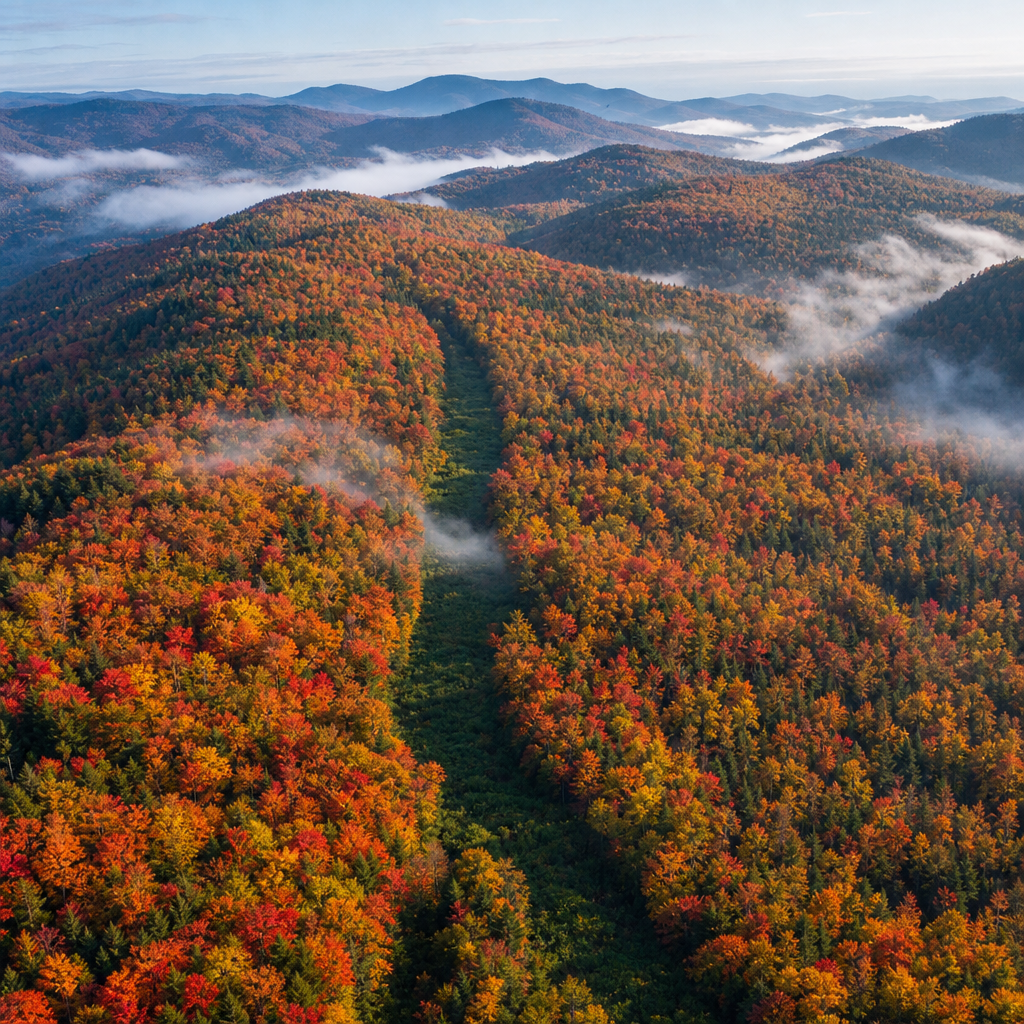
Vermont's Green Mountains stretch roughly 250 miles from the Massachusetts border to the Canadian line. The range contains more than 400,000 acres of protected Green Mountain National Forest land alone, plus hundreds of thousands of additional acres under state and private conservation management. That is not just scenic backdrop. That is a living design library.
Better Wheel VT treats the forest as a primary reference point, not a vague inspiration. The specific elevation zones of the Green Mountains, from the valley hardwood belt dominated by sugar maple, yellow birch, and beech, up through the boreal softwood transition near ridge tops, create visually distinct environments. Each of those environments generates its own set of shapes, textures, and silhouettes that feed directly into TreeSleeve™ design choices.
In practice, the seasonal shifts matter just as much as the species. The bare winter ridgeline looks nothing like the full summer canopy. The color palette of a Vermont October, burnt orange, deep burgundy, and raw umber, is genuinely different from what you find in, say, the Smokies or the Pacific Northwest. Those distinctions are what make a TreeSleeve™ design identifiably Vermont rather than generically "forest."

The Role of the Long Trail Corridor
The Long Trail, North America's oldest long-distance hiking trail, runs the full spine of the Green Mountains. It cuts through the exact terrain where Better Wheel VT sources both its design inspiration and its material. Outdoor enthusiasts who hike that corridor recognize the visual vocabulary: the layered ridgelines, the dense moss cover on exposed granite, the particular way light filters through a sugar maple canopy in late September.
When those same people hold a TreeSleeve™, they are holding something that references an experience they have actually had. That is a fundamentally different relationship than holding a neoprene sleeve printed with a generic mountain graphic.
Pro tip: If you are buying a TreeSleeve™ as a Vermont made gift for someone who has hiked the Long Trail or camped in the Green Mountain National Forest, look for the ridgeline silhouette or boreal forest designs. They will recognize the landscape immediately.
Sustainably Sourced Wood from Vermont: What That Actually Means
The phrase "sustainably sourced" gets applied to products so loosely that it has almost lost meaning. For TreeSleeve™, sustainably sourced wood Vermont is a specific operational claim, not a marketing shortcut. The hardwood comes from Vermont forests where harvesting is conducted to maintain or improve long-term forest health, rather than maximizing short-term timber yield.
Vermont's own Use Value Appraisal program (Current Use) provides a concrete framework here. Landowners who keep their land in agricultural or forest use, and manage it according to a licensed forester's plan, receive reduced property tax assessments in exchange. According to the Vermont Agency of Agriculture, Food and Markets, over 2.1 million acres of Vermont land are enrolled in this program. That enrolled acreage represents a statewide commitment to managed, responsible forestry, not clearcut extraction.
"Vermont's forests are among the most productive and best-managed in the northeastern United States, with over 75 percent of the state remaining forested." -- Vermont Department of Forests, Parks and Recreation
The practical result for TreeSleeve™ is a hardwood supply chain that stays within the regional ecosystem. The wood is not shipped from a distant softwood plantation and relabeled. It comes from the same geographic range that inspired the designs etched into its surface.
Why Provenance Changes the Value of a Gift
Eco-conscious gift shoppers are not just looking for products that do less harm. They are looking for products with a coherent story. A TreeSleeve™ has a single, traceable narrative: Vermont forest, Vermont mill, Vermont design, Vermont craftwork. That provenance loop is closed in a way that a mass-produced foam koozie from a fulfillment center cannot replicate.
The data consistently shows that provenance-based storytelling drives purchase decisions in the premium gift category. Edelman's Trust Barometer data shows that consumers increasingly expect brands to demonstrate values through operational choices, not just marketing copy. Sourcing hardwood locally and documenting that chain is an operational choice that speaks louder than a printed "eco" badge.
Pro tip: When comparing Vermont hardwood products to plastic or neoprene alternatives, ask the competing brand exactly where its raw material originates. You will rarely get a specific answer. That ambiguity is itself informative.
Vermont Hardwood Products: The Material Story Behind Every Sleeve
Vermont hardwood products have a long manufacturing history rooted in the state's furniture, flooring, and specialty woodworking industries. Sugar maple, in particular, is Vermont's signature hardwood. It is dense, smooth, and accepts engraving with exceptional clarity. Those properties make it the natural material choice for a product like TreeSleeve™, where design detail and surface finish are visible selling points.
Yellow birch is the other primary species used in Vermont's managed hardwood harvest. It has slightly more visible grain variation than sugar maple, which creates a distinctive aesthetic in finished TreeSleeve™ designs. Depending on the specific lot of wood, a birch-based sleeve will show more character in its surface, what woodworkers call "figure," than a uniformly dense maple sleeve would.
Why Hardwood Outperforms Foam and Neoprene as a Can Insulator
A common mistake is assuming that denser material means worse insulation. In practice, wood's cellular structure provides measurable thermal resistance. Wood has a thermal conductivity of roughly 0.10 to 0.17 W/mK depending on species and moisture content, compared to neoprene at approximately 0.25 W/mK. A hardwood sleeve keeps a cold can colder longer than many people expect, and it does so without petroleum-derived foam.
The biodegradability point is not trivial either. Neoprene, the material in most standard koozies, is a synthetic rubber that does not biodegrade in any practical timeframe. A TreeSleeve™ made from Vermont hardwood will return to the soil. That difference in end-of-life behavior is exactly the kind of specific, verifiable claim that eco-conscious buyers deserve to hear stated plainly.
Design Themes Rooted Directly in the Forest
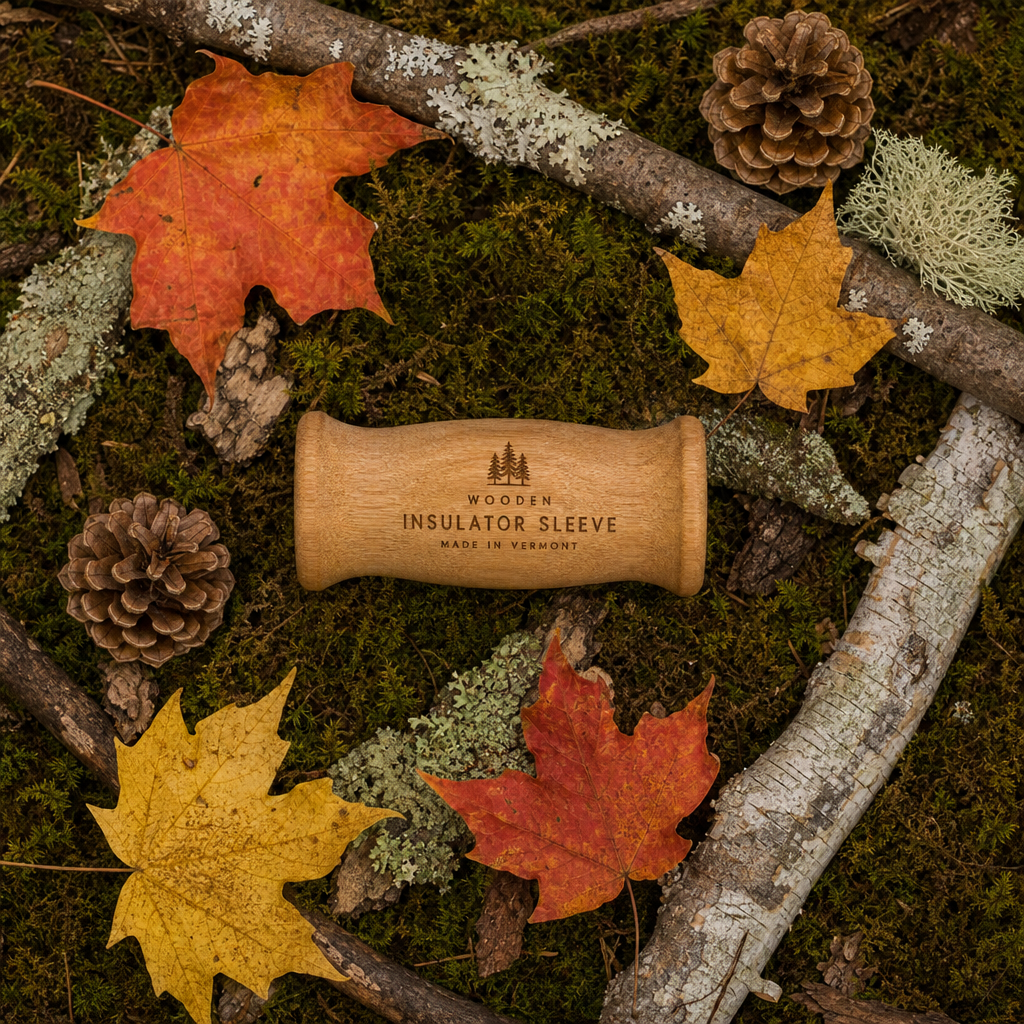
TreeSleeve™ design categories are not random. Each theme maps to something real and specific in Vermont's Green Mountain landscape. Outdoor themes reference the actual trail infrastructure, waterways, and elevation changes of the range. Wildlife motifs depict species whose ranges overlap directly with the forests where the hardwood originates.
This is a meaningful distinction from competitors like cooziecooler.com or customkoozies.com, where design options are typically generic stock art applied to foam or neoprene. Those designs could represent anywhere. A TreeSleeve™ moose motif is drawn from a species with a documented and significant population in Vermont's northern forest landscape. The wildlife is not decorative fiction.
Outdoor Themes: Reading the Ridgeline
The ridgeline silhouette designs capture what experienced hikers recognize as distinctively Vermont: the gentle, rounded Green Mountain profile versus the jagged younger peaks of the Rockies or the Whites. Vermont's mountains are old, heavily forested, and worn smooth by glaciation. That specific geological character creates a visual identity that outdoor enthusiasts from New England recognize instinctively.
Designs that reference specific trail markers, summit cairns, or valley farm panoramas visible from Green Mountain overlooks carry that same specificity. They are Vermont made gifts in the truest sense because they could not logically represent anywhere else.
Wildlife Motifs: Accuracy Over Aesthetics
A common design shortcut is to make wildlife look friendlier or more stylized than the actual animal. Better Wheel VT's wildlife motifs prioritize recognizable accuracy. The moose design reflects the animal's actual proportions, the heavy shoulder hump, the long legs, the distinctive nose. A Vermont hunter or wildlife photographer will look at it and recognize it without a label.
This accuracy builds credibility with the target audience. Outdoor enthusiasts who spend time in the Green Mountains know what these animals actually look like. Cartoonish approximations signal that the brand does not really know the territory. Accurate representation signals that it does.
Comparison of Insulator Materials and Their Environmental Impact
| Material Type | Environmental Profile | Design Specificity |
|---|---|---|
| Vermont Hardwood (TreeSleeve™) | Sustainably harvested, fully biodegradable, local supply chain, low transport footprint | Laser-engraved with place-specific motifs drawn from Green Mountain ecosystems and Vermont wildlife |
| Neoprene Foam (standard koozie) | Petroleum-derived synthetic rubber, non-biodegradable, typically manufactured offshore | Printed surface accepts nearly any design but has no material connection to Vermont or any specific place |
| Stainless Steel Sleeve | Recyclable but energy-intensive to produce, requires mining, typically imported | Engravable but heavy, and the material itself carries no regional identity or biodegradable end-of-life path |
The table above is blunt for a reason. Buyers comparing TreeSleeve™ to alternatives from sites like koozieking.com or customkoozies.com are not comparing apples to apples. They are comparing a material with a specific, documentable environmental story to materials that have no such story to tell. That is not a minor product distinction. For eco-conscious shoppers, it is the entire decision.
Why This Matters for Gift-Givers and Outdoor Enthusiasts
Giving a Vermont made gift used to mean defaulting to syrup or cheese. Those are excellent products, but they are consumables with no lasting presence. A TreeSleeve™ is a durable object that sits on a shelf, gets pulled out at campsites and backyard fires, and sparks a conversation every time someone picks it up and asks where it came from.
For outdoor enthusiasts specifically, the material integrity of a product matters as a statement of consistency. Someone who packs out their own trash on a backcountry trip is not going to feel good handing out neoprene koozies at their next camping event. A hardwood sleeve from Vermont's sustainably managed forests is consistent with how that person already thinks and lives.
Festival-Goers and Event Gifting
Vermont hosts a significant number of outdoor festivals, craft beer events, and nature-focused gatherings throughout the year. Custom TreeSleeve™ options are a direct fit for this context. A festival organizer can create event-specific designs that reference the venue's actual landscape, whether that is a specific Green Mountain valley, a local river corridor, or a named trail system.
The result is a keepsake that festival-goers will actually keep, because it connects to a specific experience rather than being a generic giveaway item. In practice, this is exactly the kind of product that ends up photographed and shared, generating organic reach for both the event and the brand.
According to Statista, the global sustainable gift market is growing at a compound annual rate that reflects a significant and sustained shift in consumer values. Buyers in this category are not making impulsive decisions. They research. They compare. And they respond to products with coherent, verifiable environmental credentials far more than to vague "green" claims.
Frequently Asked Questions
What types of Vermont hardwood are used in TreeSleeve™ insulators?
TreeSleeve™ insulators are crafted primarily from sugar maple and yellow birch, two of the dominant hardwood species in Vermont's Green Mountain forests. Both species are managed under responsible forestry practices, and each brings a slightly different grain character to the finished product. Sugar maple produces a denser, more uniform surface, while yellow birch shows more natural figure variation.
Are TreeSleeve™ designs actually based on Vermont's specific landscape, or is that just marketing?
The designs are genuinely Vermont-specific. Wildlife motifs reflect species with documented Green Mountain populations. Ridgeline silhouettes reference the actual geological profile of the Green Mountains, which is visually distinct from other New England ranges. Outdoor themes draw from real trail infrastructure and ecosystem zones rather than generic forest imagery.
How does a wood can insulator perform compared to a standard neoprene koozie?
Wood's thermal conductivity is measurably lower than neoprene in standard comparative terms, meaning it transfers heat more slowly. In practice, a TreeSleeve™ keeps a cold can at an acceptable drinking temperature for a comparable time to a foam koozie. The primary material advantage is not purely thermal performance but rather the end-of-life story: wood biodegrades, neoprene does not.
Can I get a custom TreeSleeve™ that references a specific Vermont trail, lake, or landmark?
Yes. Better Wheel VT offers custom design options that can incorporate specific Vermont landmarks, trail outlines, lake contours, or local place names. This makes custom TreeSleeve™ sleeves particularly strong Vermont made gifts for people with a specific connection to a Vermont location, whether that is a hiking destination, a camp, or a hometown.
What makes TreeSleeve™ different from the wooden koozies sold by competitors?
The key differences are sourcing specificity and design integrity. Competitors selling wooden or wood-look insulators typically do not document where their wood originates or connect their designs to a specific regional identity. TreeSleeve™ uses sustainably sourced hardwood from Vermont's own managed forests and builds its design language directly from the Green Mountain landscape, creating a product with a coherent and verifiable story from raw material to finished gift.
Is TreeSleeve™ appropriate for someone who does not drink beer?
Completely. The sleeve fits standard 12-ounce cans, which covers sparkling water, hard cider, seltzers, and most canned beverages. The design appeal and material quality make it a usable gift for any outdoor enthusiast who uses canned beverages in field settings, regardless of what is in the can.
Have you given or received a TreeSleeve™ as a Vermont made gift? Share what design resonated most with you and why in the comments.
References
- Statista data on sustainable consumer goods market trends and eco-gift spending growth
- United States Forest Service information on Green Mountain National Forest acreage and management practices
- Vermont Agency of Agriculture, Food and Markets resources on the Current Use forestry enrollment program
- Forbes reporting on consumer demand for sustainable, provenance-driven product categories
- Vermont Department of Forests, Parks and Recreation data on statewide forest cover and hardwood species management
Share:
Unique Outdoor Gifts for People Who Have Everything
10 Reasons a Hardwood Can Sleeve Beats Foam Every Time