Most people who pick up a wooden product never think about where the wood came from. That is a mistake. The source of the wood determines everything from its durability and grain quality to whether harvesting it helped or hurt a living forest. Vermont hardwood has earned a specific reputation in the eco-product world, and it is not because of marketing. The Green Mountains produce some of the most responsibly managed timber in North America, and that distinction shows up directly in the quality of finished goods, including the TreeSleeve by Better Wheel VT.
Table of Contents
- Quick Takeaways
- What Makes Vermont Hardwood Unique
- Sustainably Sourced Wood: The Vermont Standard
- Green Mountains Vermont and Forest Health
- Why Hardwood Beats Plastic for Eco Products
- Comparing Wood Sourcing Approaches
- How TreeSleeve Uses Vermont Hardwood
- Frequently Asked Questions
- References
Quick Takeaways
| Key Insight | Explanation |
|---|---|
| Vermont forests are among the most regulated in the U.S. | State-level forestry laws and third-party certification programs ensure that harvested timber is replaced and ecosystems stay intact. |
| Hardwood density matters for product longevity | Species like sugar maple and yellow birch grown in Vermont's cold climate develop tighter grain rings, which translates to stronger, longer-lasting products. |
| Biodegradability is not optional for truly eco-friendly goods | Vermont hardwood breaks down naturally at end of life. Neoprene and foam insulators do not. This is the clearest line between greenwashing and genuine sustainability. |
| Local sourcing cuts carbon footprint significantly | Using timber harvested within the state eliminates thousands of miles of shipping, which is one of the largest carbon contributors in the supply chain for comparable products. |
| Vermont's working forests support rural economies | Choosing sustainably sourced Vermont wood keeps revenue inside local communities and funds ongoing forest management, creating a measurable positive loop. |
| Grain and figure variation makes each piece unique | No two pieces of Vermont hardwood look identical. For products like can insulators, this means every TreeSleeve has a distinct appearance that mass-produced foam products can never replicate. |
| Cold-climate hardwoods outperform tropical imports on stability | Vermont hardwoods are naturally acclimated to temperature swings, making them less prone to warping or cracking in outdoor conditions, which is exactly where outdoor enthusiasts use products like TreeSleeve. |
What Makes Vermont Hardwood Unique

Vermont is not simply another forested state. It is one of the most heavily forested states in the entire country, with approximately 78 percent of its land covered by trees, according to the Vermont Department of Forests, Parks and Recreation. That density is not an accident. It is the result of deliberate, multi-decade conservation efforts combined with strict timber harvesting regulations that most other states have not matched.
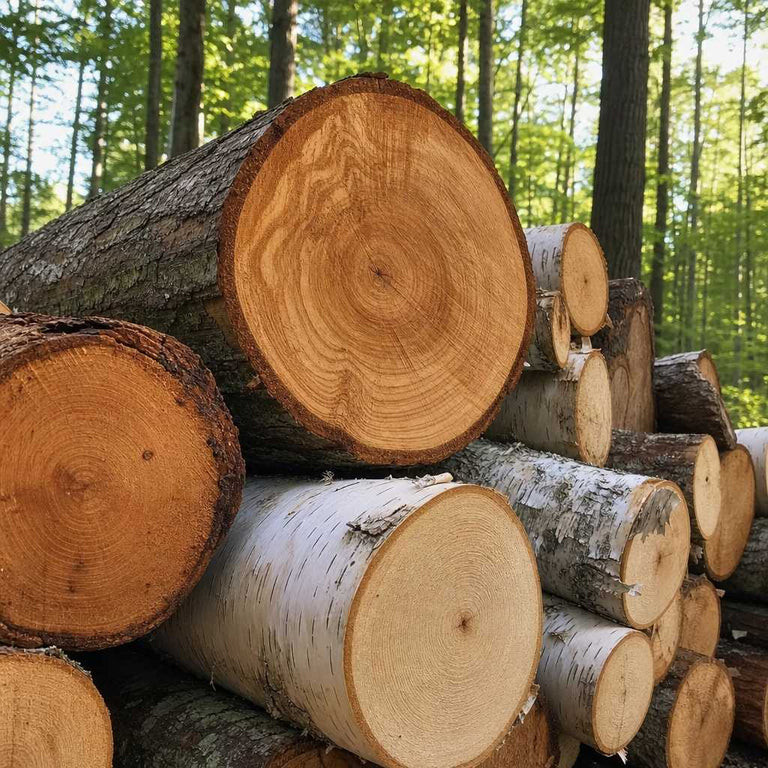
The species profile matters too. Vermont's hardwood forests are dominated by sugar maple, yellow birch, American beech, and red maple. These are all slow-growing hardwoods that develop dense, tightly packed grain structures because of the long, cold winters and distinct seasonal cycles of the region. Slow growth means more rings per inch of wood, and more rings per inch means higher density and durability in the finished product.
Cold Climate Growth and Wood Density
In practice, trees grown in colder climates produce wood with measurably different physical properties than the same species grown in warmer southern states. The dormant winter period forces the tree to grow more slowly, concentrating the cellular structure. Sugar maple from Vermont, for example, consistently registers higher on the Janka hardness scale than maple grown in milder climates.
This is not a minor difference. For a product like the TreeSleeve can insulator that needs to hold its shape, resist moisture, and survive the bumps and drops of outdoor use, that extra density is a direct functional advantage. It is the same reason Vermont maple is sought after for hardwood flooring and butcher blocks.
Natural Figure and Aesthetic Character
Vermont hardwoods also produce consistent figure variations, including bird's eye, curly, and quilted patterns in sugar maple. These occur because of specific stress conditions during growth and are highly valued in fine woodworking. For eco-product makers, this variation means every item has an inherent authenticity that no synthetic material can imitate.
Pro tip: When evaluating any wood-based eco product, ask specifically where the timber was sourced and whether it came from a certified sustainable operation. A vague answer like "natural wood" without a region or certification tells you almost nothing about actual environmental impact.
Sustainably Sourced Wood: The Vermont Standard
The phrase "sustainably sourced wood" gets used loosely. In Vermont, it has a concrete meaning backed by regulatory and certification infrastructure that most consumers never see but absolutely benefit from.
Vermont's Current Use program and Act 250 land use law create strong disincentives for clear-cutting and ecologically destructive harvesting. Landowners who harvest timber unsustainably risk losing favorable tax treatment and facing regulatory review. The result is a forest that is actively managed rather than simply exploited.
Third-Party Certification Programs
Many Vermont timber operations hold certification through the Forest Stewardship Council (FSC) or the Sustainable Forestry Initiative (SFI). These programs require independent audits of harvesting practices, regeneration planning, biodiversity protection, and worker treatment. According to the Forest Stewardship Council, certified operations must demonstrate that harvesting rates do not exceed the forest's ability to regenerate, which is the most basic definition of sustainability done correctly.
"Sustainable forest management is not just about trees. It is about maintaining the full range of ecological, social, and economic values that forests provide." - Forest Stewardship Council, Principles and Criteria
This is why sustainably sourced wood from Vermont carries more credibility than similar claims from regions without equivalent oversight. The infrastructure to verify and enforce those claims actually exists here.
Regeneration Rates and Long-Term Forest Health
Vermont's forest cover has actually increased over the past century, not decreased. The USDA Forest Service reports that the Northeast, including Vermont, has seen net forest growth for decades. This is a direct outcome of managed harvesting combined with a shift away from agriculture on marginal land. The forests are getting bigger and healthier while still producing usable timber. That is what a genuinely sustainable system looks like from the outside.
Pro tip: When gifting a wood-based eco product, look for ones that explicitly name the forest region and the harvest certification. It is a small detail that signals the maker is telling the full story, not just using "eco" as a label.
Green Mountains Vermont and Forest Health
The Green Mountains of Vermont form the geographical backbone of the state's timber industry. Stretching roughly 250 miles from north to south, this range creates the elevation gradients and microclimate variation that produce some of the most diverse hardwood stands in the Northeast. The combination of granite-based soils, significant snowpack, and reliable spring melt cycles creates conditions where hardwoods grow vigorously during warm months and harden during cold months.
This hardening cycle is not simply a curiosity of forest biology. It is the mechanism that produces the wood density and moisture resistance that makes Vermont hardwood particularly suitable for products used outdoors. Anyone who has taken a wooden product camping or to a music festival knows that outdoor conditions test material quality quickly.
Biodiversity as a Quality Indicator
Healthy forests in the Green Mountains support a broad mix of species, including sugar maple, yellow birch, American beech, white ash, and basswood. This biodiversity is itself an indicator of forest health. Monoculture timber operations produce wood faster but at the cost of soil quality, wildlife habitat, and resilience against disease. Vermont's mixed hardwood forests produce slower but produce wood from a biologically stable system.
For eco-product makers sourcing from these forests, that biodiversity matters because it means the supply chain is not extracting from a depleted system. The forest that provided timber for a TreeSleeve today is structurally the same forest that will provide timber in twenty years.

Why Hardwood Beats Plastic for Eco Products
Neoprene, foam, and synthetic rubber are the standard materials for can insulators sold by competitors. These materials are cheap to produce at scale and comfortable to handle. They are also petroleum-derived, non-biodegradable, and impossible to recycle through standard municipal programs. A neoprene can cooler that ends up in a landfill will still be structurally intact decades later.
Vermont hardwood breaks down naturally. A TreeSleeve that reaches the end of its useful life can be composted or simply left in a natural environment where it will decompose within a few years. This is the difference between a product that ends and a product that accumulates.
Carbon Sequestration and the Wood Advantage
Wood products store the carbon that the tree absorbed during its lifetime. This is called carbon sequestration, and it is one of the most significant environmental advantages of wood over synthetic alternatives. A piece of Vermont maple in a finished product is holding carbon out of the atmosphere for the life of that product. When the product does eventually biodegrade, that carbon returns to the soil rather than the atmosphere in a slow, distributed process that is nothing like burning fossil fuels.
The USDA Forest Service estimates that U.S. forests, including those in Vermont, sequester approximately 866 million metric tons of carbon dioxide equivalent annually. Sustainably harvested wood products extend that sequestration beyond the forest itself.
The Greenwashing Problem with Competing Products
A common mistake buyers make is equating natural-looking aesthetics with genuine sustainability. Some competing can insulator brands market recycled content or nature-themed prints without addressing the core material problem. A foam insulator with a mountain graphic on it is still a foam insulator. The material matters more than the imagery. Vermont hardwood is the material, not a decoration on top of a synthetic base.
Comparing Wood Sourcing Approaches
Not all wood used in consumer products comes from equivalent sources. The table below compares the three most common sourcing approaches used by makers of wood-based eco products, so buyers can evaluate claims with a clear reference point.
| Sourcing Approach | Environmental Accountability | Impact on Product Quality |
|---|---|---|
| Certified local sourcing (Vermont FSC or SFI certified) | Highest. Third-party audited, legally regulated, traceable to specific forest management units. Regeneration is verified, not assumed. | Highest. Cold-climate growth produces dense, stable, moisture-resistant grain. Species identity is known and consistent. |
| Generic domestic hardwood (unspecified U.S. origin) | Moderate. Subject to U.S. federal logging laws but without regional certification or independent auditing. Accountability depends entirely on the individual supplier. | Variable. Wood quality depends heavily on species, growing region, and how the lumber was dried and processed. Consistency is not guaranteed. |
| Imported tropical hardwood (teak, mahogany, etc.) | Lowest in most cases. Many tropical sourcing regions have weak enforcement of forestry laws. Shipping distance adds significant carbon cost regardless of harvest method. | Variable to high for certain species, but climate-related properties that suit outdoor use in Vermont are not transferable from tropical growth conditions. |
The comparison above makes the case clearly. Certified local sourcing from Vermont is not just the most ethical choice. It is also the choice that produces the most consistent, highest-quality raw material for finished eco products.
How TreeSleeve Uses Vermont Hardwood
Better Wheel VT built TreeSleeve specifically around the properties of Vermont hardwood rather than adapting a generic product concept to use wood as a novelty material. That distinction changes everything about how the product performs and what it represents.
The outdoor and wildlife design themes on TreeSleeve are not arbitrary. They reflect the actual ecosystem that produced the material. A can insulator made from Green Mountains maple and decorated with Vermont wildlife motifs is making a coherent statement, not a decorative one. The product and its origin story are the same story.
Custom Options and the Traceability Advantage
TreeSleeve's custom design options extend the traceability advantage. When a buyer selects a custom TreeSleeve for a gift, they are choosing a product where the material source, the manufacturing location, and the design intent all point in the same direction. That kind of full-chain coherence is rare in the gift product market, where many items are designed in one place, manufactured in another, and sourced from a third location with no connecting narrative.
For eco-conscious gift shoppers, this matters. Giving a TreeSleeve to an outdoor enthusiast or beer lover is not just giving a can insulator. It is giving a piece of Vermont's forest history with a functional life ahead of it and a responsible end of life after that.
Why Outdoor Enthusiasts Specifically Value This Material
Outdoor use exposes products to UV light, moisture, temperature swings, and physical impact. Vermont hardwood handles these conditions better than synthetic foam alternatives because its cellular structure was built to manage exactly those stresses. The tree survived Vermont winters for decades before becoming a TreeSleeve. That durability does not disappear when the wood is shaped into a product.
Festival-goers and hikers who reach for a TreeSleeve are also reaching for something that does not feel cheap or temporary. The weight and texture of real wood communicates quality in a way that compressed foam never will. That tactile quality is a direct property of the material's density, which is a direct outcome of how Vermont hardwood grows.
Frequently Asked Questions
Is Vermont hardwood actually stronger than hardwood from other states?
For cold-climate species like sugar maple and yellow birch, yes. The slower growth rate forced by Vermont's long winters produces tighter grain rings, which increases density and hardness compared to the same species grown in warmer, faster-growing conditions. This is measurable using the Janka hardness test and is well documented in commercial lumber grading data.
What does sustainably sourced wood actually mean in practice?
It means the timber was harvested from a forest where the rate of cutting does not exceed the rate of natural regeneration, where biodiversity and wildlife habitat are protected during operations, and where these practices are verified by an independent auditing body like the Forest Stewardship Council or the Sustainable Forestry Initiative. Without third-party certification, the claim is self-reported and unverifiable.
How does a wooden can insulator like TreeSleeve compare to neoprene koozies for outdoor use?
TreeSleeve holds cold temperature for a comparable duration to foam alternatives and offers a much more durable physical structure for outdoor conditions. More importantly, it does not contribute to plastic pollution at end of life. Neoprene and foam insulators degrade slowly in landfills. Vermont hardwood biodegrades completely in natural environments.
Are the Green Mountains of Vermont actually a different environment from other Northeast forest regions?
Yes, meaningfully so. The elevation range, granite-based soil composition, and specific precipitation and snowpack patterns in the Green Mountains create microclimate conditions that support dense mixed hardwood stands with distinctive growth characteristics. The same species grown in flatter, warmer Northeast regions produces wood with measurably different properties.
Why is local sourcing better than importing exotic wood for eco products?
Transportation is one of the largest carbon costs in any supply chain. Importing tropical hardwood from Southeast Asia or South America to make an "eco-friendly" product in Vermont adds thousands of miles of shipping emissions before the product is even made. Local sourcing eliminates that cost entirely. It also supports local economies and keeps accountability closer to home, where enforcement of sustainable practices is more consistent.
Can a wood product really be fully biodegradable?
Yes, when it is made from untreated or naturally finished hardwood without synthetic coatings or adhesives. Vermont hardwood products that use natural oil finishes will decompose completely in soil over a period of a few years. This stands in direct contrast to plastic, foam, and synthetic rubber products that persist in landfills for decades or centuries.
We would love to hear your experience with Vermont hardwood products or sustainably sourced eco gifts. Share your thoughts in the comments or reach out through the Better Wheel VT website.
We would love your feedback and any insights you would share with others. What perspective would you add?
References
- USDA Forest Service research on U.S. forest carbon sequestration and sustainable timber management data
- Forest Stewardship Council principles and criteria for certified sustainable forest operations worldwide
- Statista data on consumer demand for sustainable and eco-friendly products in the United States
- U.S. Environmental Protection Agency guidance on biodegradable materials and plastic waste in landfills
- Forbes reporting on the growth of the eco-conscious consumer market and sustainable gifting trends
Share:
Father's Day Gifts for Outdoorsy Dads: 2024 Guide
Father's Day Gifts for Outdoorsy Dads: 2024 Guide