Roughly 40 percent of all gift purchases in the United States end up as waste within weeks of the occasion, according to data tracked by the EPA. That number should bother every shopper who thinks of themselves as environmentally responsible. The rise of biodegradable gifts 2026 is not a marketing trend cooked up by brands looking for an easy angle. It is a direct response to a measurable problem: conventional gifts, from plastic-wrapped novelties to foam koozies, leave behind material that persists in landfills for decades. Shoppers are beginning to hold their purchasing decisions to the same standard they hold their lifestyle choices, and that shift is reshaping what the best gifts look like.
Table of Contents
- Quick Takeaways
- Why Biodegradable Gifts Are Replacing Plastic Novelties
- What Eco-Conscious Gift Shopping Actually Means in 2026
- Sustainable Gift Ideas That Hold Up Beyond the Occasion
- Why the TreeSleeve Sets a New Bar for Biodegradable Gifting
- Comparing Biodegradable vs. Conventional vs. Recycled Gift Options
- How to Shop for Biodegradable Gifts Without Getting Greenwashed
- Frequently Asked Questions
- References
Quick Takeaways
Key Insight |
Explanation |
|---|---|
Biodegradable gifts reduce landfill load at the product level |
Unlike recycled products that still require industrial processing, biodegradable materials break down naturally without facility intervention. |
Sustainably sourced wood outperforms neoprene foam in environmental cost |
Neoprene, the material in most standard koozies, is petroleum-derived and non-biodegradable. Hardwood from managed forests has a fraction of that footprint. |
Eco-conscious gift shoppers prioritize function alongside values |
A gift that looks good, works well, and breaks down safely is more persuasive than a gift that only checks the sustainability box. |
Greenwashing is a real obstacle in the biodegradable gift market |
Claims like "eco-friendly" without material sourcing transparency are often marketing language, not verified environmental credentials. |
Outdoor enthusiasts are the fastest-growing segment for sustainable gifting |
People who spend time in nature have direct, personal reasons to care about product waste. This audience responds strongly to genuine material claims. |
Custom biodegradable gifts command premium pricing without resistance |
When a product is unique, functional, and environmentally honest, shoppers consistently report willingness to pay more than for generic alternatives. |
Vermont hardwood offers a traceable, local sustainability story |
Products made from regionally sourced materials allow buyers to verify the supply chain in ways that imported "natural" materials rarely permit. |
Why Biodegradable Gifts Are Replacing Plastic Novelties
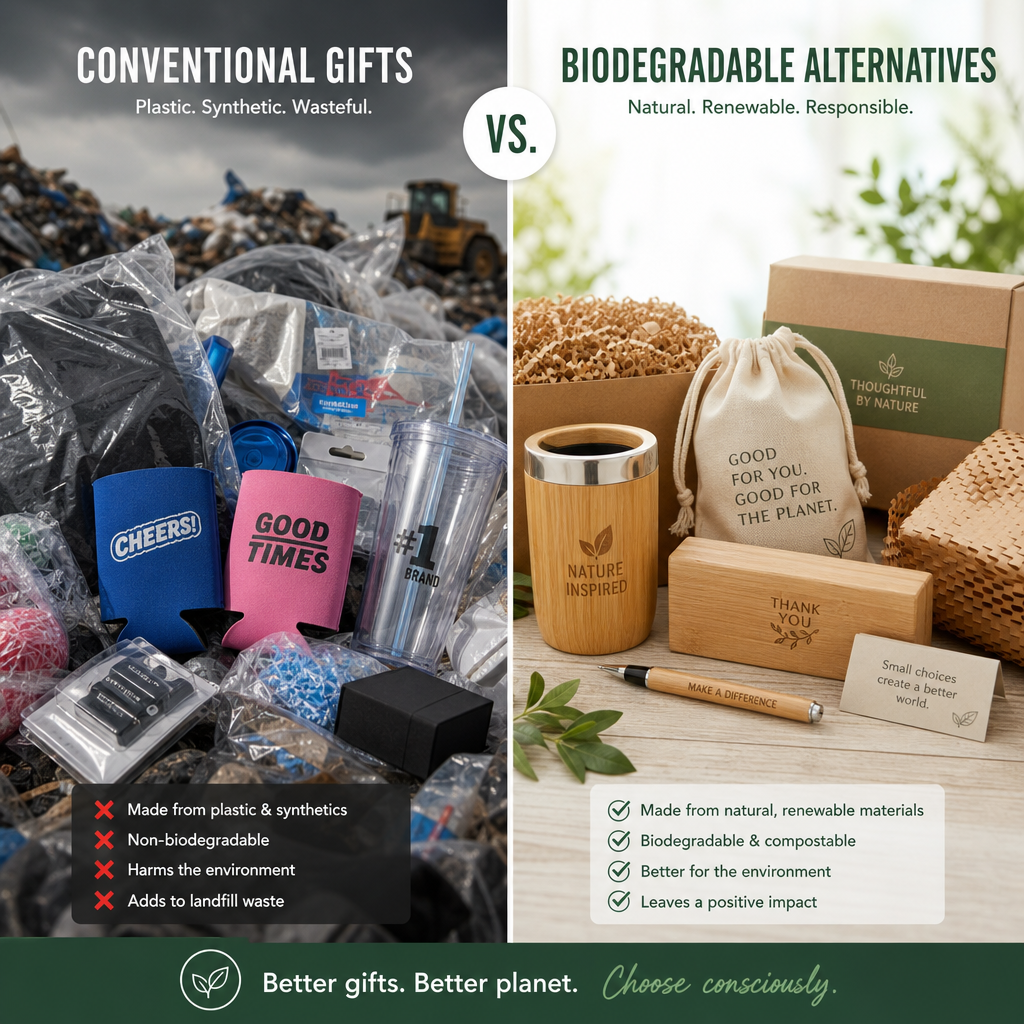
The conventional novelty gift market built itself on low material costs. Foam, plastic, and synthetic fabrics became the default because they were cheap to produce and easy to customize. The problem is that cheapness in manufacturing never accounted for end-of-life cost. A foam beverage insulator that costs a dollar to make can sit in a landfill for five hundred years.
Shoppers in 2026 are not just aware of that tradeoff. They are actively rejecting it. According to a McKinsey consumer survey, over 66 percent of respondents said they consider sustainability when making a purchase decision, and that number climbs to 73 percent among millennials. These are the people buying birthday gifts, festival supplies, and outdoor gear. They are not a niche group anymore.
Biodegradable gifts fill the gap between wanting to give something meaningful and not wanting to contribute to a waste problem. When a product is made from sustainably harvested hardwood, engraved with a design that actually means something to the recipient, and guaranteed to return to the earth without leaving toxic residue, it satisfies both sides of the gift-giving equation.
Pro tip: When evaluating whether a gift is genuinely biodegradable, ask specifically what the product is made from and how long decomposition takes under normal outdoor conditions. A real biodegradable product will have a specific answer. A greenwashed one will not.
The Role of Novelty Gift Waste in the Broader Plastic Problem
Single-use and short-use novelty items make up a disproportionate share of consumer plastic waste. Festival merchandise, promotional koozies, and branded giveaways are designed to be used briefly and then discarded. The materials used in most of these products, including expanded polystyrene and neoprene foam, are not accepted by curbside recycling programs in most U.S. municipalities.
The practical result is that the vast majority of those products go directly to landfill. Switching to a hardwood alternative like the TreeSleeve from Better Wheel VT is not a symbolic gesture. It is a material choice with a measurable different outcome at the product's end of life.
What Eco-Conscious Gift Shopping Actually Means in 2026
Eco-conscious gift shopping has evolved past the phase where buying anything labeled "green" felt sufficient. Shoppers have been burned by greenwashing enough times to develop real skepticism. The standard has moved from intention to verification.
In practice, eco-conscious shoppers in 2026 are asking three specific questions before purchasing. First, what is this actually made from? Second, where did that material come from? Third, what happens when I am done with it? A product that cannot answer all three questions with specificity does not meet the new standard, regardless of what the packaging says.
"Consumers are moving from brand trust to material trust. They want to know what the product is, not just what the brand believes in." - McKinsey Sustainability Insights, 2024
This is exactly why products like the TreeSleeve connect so directly with this audience. Vermont-sourced hardwood is a material claim that can be verified. Sustainable forestry certification is a process claim that has third-party standards behind it. Full biodegradability is a decomposition claim that does not require a special facility. These are answers, not aspirations.
Why Outdoor Enthusiasts Lead the Eco-Gift Shift
People who hike, camp, kayak, and spend time in Vermont forests do not need to be convinced that single-use plastic is a problem. They see it. They pull it out of rivers. They pack it out on trails where someone else left it behind. That firsthand experience creates a different kind of purchasing conviction than any marketing message can generate.
This is the audience that gravitates naturally toward a can insulator made from the same forests they recreate in. It is not an abstract environmental statement for them. It is a consistent extension of choices they already make every day.
Sustainable Gift Ideas That Hold Up Beyond the Occasion
A common mistake in eco-conscious gifting is conflating "sustainable" with "forgettable." The assumption that environmentally responsible products must sacrifice personality or craftsmanship has kept a lot of genuinely good products out of gift conversations. That assumption is wrong, and the best sustainable gift ideas in 2026 prove it.
The most effective sustainable gifts share two characteristics. They are built from materials with a clear environmental story, and they are specific enough to feel personal. Generic is the enemy of a good gift regardless of what the product is made from.
Pro tip: For outdoor enthusiasts, the most impactful sustainable gifts connect to something they actually do outdoors, not just to general nature appreciation. A hardwood can insulator with a Vermont wildlife design lands differently than a generic bamboo item with no regional identity.
Categories Where Biodegradable Materials Win Over Conventional Options
Beverage accessories are one of the clearest examples of where biodegradable materials outperform conventional alternatives on every dimension that matters to eco-conscious shoppers. A standard foam koozie costs almost nothing, keeps drinks cold adequately, and ends up in a landfill. A hardwood insulator like the TreeSleeve keeps drinks equally cold, looks significantly better, carries a design that means something, and breaks down completely when its useful life ends.
The price difference is real, but the value proposition is also real. A gift that someone keeps on their counter or takes to every tailgate for years is worth more than a promotional item that gets lost within a week. The data consistently shows that perceived value and actual use duration track together, meaning gifts people actually use justify higher price points.
Why the TreeSleeve Sets a New Bar for Biodegradable Gifting
Most products described as eco-friendly in the beverage accessory space are making one narrow material claim. They might use recycled content, or plant-based dyes, or minimal packaging. The TreeSleeve from Better Wheel VT is not making one narrow claim. It is operating on a different premise entirely.
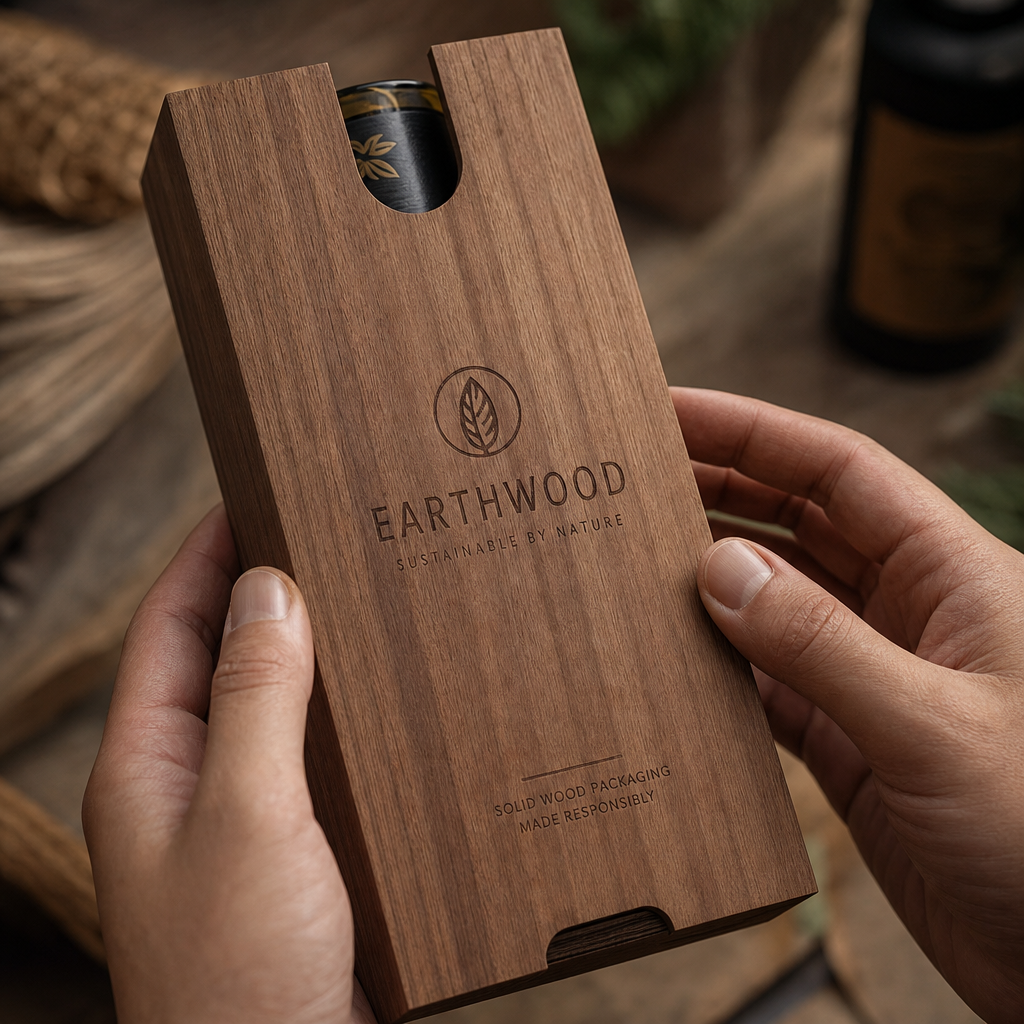
The product starts with sustainably sourced hardwood from Vermont forests. That is a local, traceable, renewable material with a forestry management story behind it. It is then crafted into a functional can insulator with design options that include outdoor themes, Vermont wildlife motifs, and custom engravings. When the product eventually reaches end of life, it biodegrades completely. No industrial facility required.
What separates this from competitors like cooziecooler.com or customkoozies.com is not just the material. It is the specificity of the environmental claim and the regional identity of the product. Those competitors offer customization on petroleum-derived foam. Better Wheel VT offers customization on a material that belongs to the natural world the buyer is trying to protect.
Custom Options That Make the Environmental Story Personal
The custom option at Better Wheel VT is not just a personalization feature. It is an opportunity for the gift-giver to extend the story of the product. A TreeSleeve engraved with a specific mountain range, a trail name, or a wildlife design meaningful to the recipient turns a functional item into a statement about shared values.
This is increasingly how eco-conscious shoppers want to give gifts. Not just "here is a sustainable thing" but "here is something made with care, from a place that matters, that reflects what we both believe about how to live." That is a different gift experience than anything foam can offer.
Comparing Biodegradable vs. Conventional vs. Recycled Gift Options
Not all environmentally positioned gifts are equivalent, and treating them as interchangeable is one of the most common mistakes eco-conscious shoppers make. The table below lays out the honest differences between the three main categories.
Gift Type |
Material Reality |
End-of-Life Outcome |
|---|---|---|
Biodegradable (e.g., TreeSleeve hardwood) |
Sustainably harvested natural material, no synthetic additives, engraved not printed |
Fully breaks down in natural conditions, no landfill residue |
Recycled synthetic (e.g., recycled foam koozies) |
Post-consumer plastic content, still petroleum-derived, requires industrial recycling stream |
May be recyclable again but still contributes to plastic infrastructure dependency |
Conventional (e.g., standard neoprene koozies) |
Virgin petroleum-derived neoprene or foam, low material cost, often not recyclable |
Landfill destination in virtually all cases, persists for centuries |
The comparison is not subtle. Recycled options are meaningfully better than conventional ones, but they are not biodegradable. They still depend on industrial recycling infrastructure that fails to capture most consumer products at actual end-of-life. Biodegradable hardwood gifts do not require that infrastructure at all.
How to Shop for Biodegradable Gifts Without Getting Greenwashed
Greenwashing in the gift market is aggressive and sophisticated. Terms like "natural," "earth-friendly," "green," and even "eco-conscious" have no regulatory definition in the United States. Any brand can use them without any material or process verification behind the claim.
The Federal Trade Commission's Green Guides provide the clearest framework for evaluating environmental marketing claims. The Guides specifically warn against broad unqualified environmental claims and require that specific claims like "biodegradable" be truthful, not misleading, and supported by competent scientific evidence. A product claiming to be biodegradable should be able to tell you what it is made from and how long decomposition takes in typical disposal conditions.
In practice, the fastest way to identify a genuine biodegradable gift is to look at three things: the specific material, the sourcing documentation, and whether the brand distinguishes their product from synthetic alternatives with real technical language rather than vague aspirational copy.
Red Flags That Signal Greenwashing in Gift Products
Watch for products that call themselves eco-friendly but use neoprene, polyurethane foam, or PVC in any component. Watch for "made with natural materials" when those natural materials represent a small percentage of the product. Watch for brands that cannot tell you specifically where their raw materials come from or whether they are certified by any third-party forestry or materials standard.
Better Wheel VT's position is the opposite of those patterns. The material is Vermont hardwood. The sourcing is regional and verifiable. The product is fully biodegradable because wood is wood, and it decomposes the way wood does. There is nothing complicated or hidden in that claim.
Frequently Asked Questions
What makes a gift truly biodegradable rather than just eco-friendly?
A truly biodegradable gift is made entirely from materials that break down naturally through biological processes without leaving toxic residue. Wood, untreated natural fibers, and certain plant-based materials meet this standard. Products made from neoprene, polyurethane foam, or synthetic composites do not, regardless of how they are marketed. Always ask what percentage of the product by weight is actually biodegradable, and under what conditions.
Are biodegradable can insulators as effective as foam koozies at keeping drinks cold?
Yes. Hardwood has natural insulating properties that perform comparably to foam for keeping canned beverages cold over typical use periods of 30 to 60 minutes. The TreeSleeve specifically is designed to fit standard 12-ounce cans and maintains temperature effectively. The functional performance is not a tradeoff. It is equivalent to conventional foam with a dramatically better environmental outcome.
Who are the best recipients for biodegradable gifts in 2026?
Outdoor enthusiasts, hikers, campers, festival-goers, beer lovers, and anyone who already makes environmentally conscious choices in their daily life will respond most strongly to biodegradable gifts. These recipients appreciate when a gift reflects shared values rather than just serving a function. Custom options with Vermont wildlife or outdoor themes add a personal dimension that generic gifts cannot match.
How does buying from Better Wheel VT differ from buying a standard custom koozie online?
Standard custom koozie services like customkoozies.com or koozieking.com produce foam or neoprene products that persist in landfills indefinitely. Better Wheel VT produces the TreeSleeve from sustainably sourced Vermont hardwood that is fully biodegradable. Beyond the environmental difference, the craftsmanship and regional identity of a hardwood product is materially different from a printed foam sleeve. The customization options at Better Wheel VT are engraved into the wood, not printed on synthetic material.
Is paying more for a biodegradable gift worth it compared to a conventional option?
The data consistently shows that gifts people actually use and keep have higher perceived value and longer useful lives than inexpensive novelty items. A TreeSleeve that someone uses for three years at every tailgate, camping trip, and backyard gathering delivers more value per dollar than a foam koozie that gets lost in a week. The environmental benefit is a real add-on, not the only justification for the price difference.
Can biodegradable gifts work as bulk or event gifts for festivals and outdoor events?
Absolutely. The TreeSleeve is well suited for outdoor events, festivals, and group gifts precisely because it connects to the outdoor context of the event. Custom engraving options allow event organizers to include a design, name, or date that makes the item a keepsake rather than a throwaway. For eco-conscious events specifically, giving a biodegradable product as a branded item is a consistent signal that the event's stated values extend to its merchandise.
What has been your experience finding biodegradable gifts that actually deliver on their environmental claims? Share your thoughts below.
References
McKinsey research on consumer sustainability priorities and purchasing behavior
FTC Green Guides on environmental marketing claims and biodegradability standards
Statista data on sustainable consumer goods market growth and eco-conscious shopping trends
Forbes reporting on the rise of eco-conscious gifting and greenwashing in consumer markets
Share:
Biodegradable Gifts 2026: The New Eco-Conscious Standard
Biodegradable Gifts 2026: The New Eco-Conscious Standard