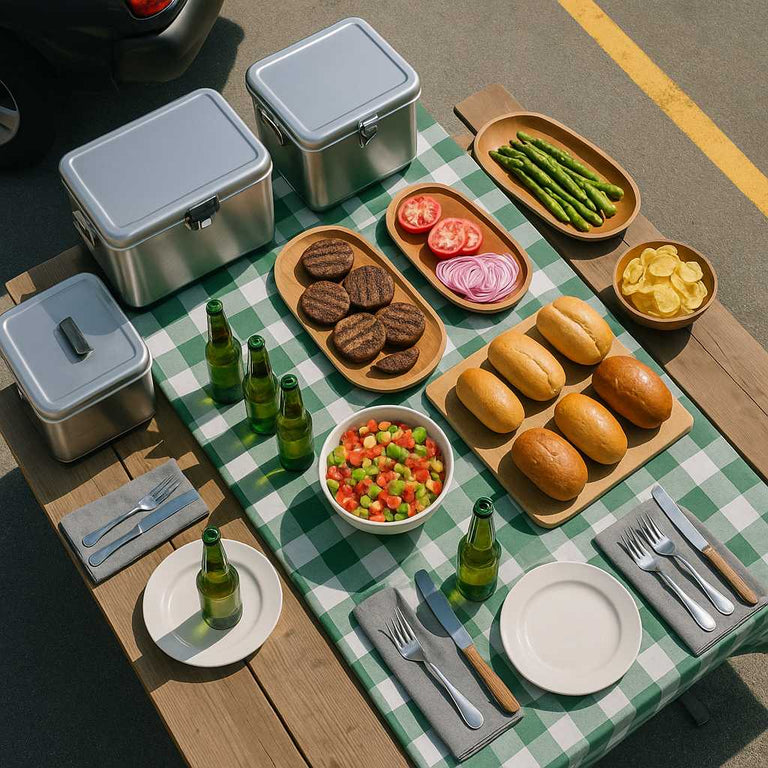
Most tailgates generate an embarrassing amount of waste. The average NFL game day event produces roughly 50 pounds of trash per tailgater, according to waste audit data cited by the Green Sports Alliance. Single-use plastic cups, foam cooler inserts, cheap throwaway koozies, and paper plates pile up in stadium parking lots from August through February. If you love the outdoors and you love sports, that tension is real. This guide cuts through the greenwashing and gives you a practical, opinionated playbook for eco-friendly tailgating that does not sacrifice the fun, the flavor, or the cold beer.
Table of Contents
- Quick Takeaways
- Why Green Tailgate Ideas Actually Matter
- Gear That Earns Its Place at a Sustainable Outdoor Sports Fan Setup
- Food and Drink Without the Disposable Disaster
- The Insulator Problem: Why Most Koozies Are an Eco Disaster
- Comparison: Three Approaches to Eco-Friendly Tailgating
- Zero-Waste Setup Checklist for Game Day
- Gifting the Sustainable Outdoor Sports Fan
- Frequently Asked Questions
- References
Quick Takeaways
| Key Insight | Explanation |
|---|---|
| Single-use foam and plastic insulators are the biggest per-item waste offender at tailgates | They crush, crack, and go straight to landfill. Switching to a biodegradable or reusable insulator removes one of the most visible pieces of tailgate trash. |
| Sustainably sourced hardwood insulators fully biodegrade at end of life | Products like the TreeSleeve from Better Wheel VT are made from Vermont hardwood and break down naturally, unlike neoprene or foam alternatives. |
| Reusable serveware cuts per-event waste by up to 70 percent | Studies on event waste show that swapping disposables for stainless or bamboo serveware is the single highest-impact change most tailgaters can make. |
| Green tailgate ideas do not require spending more money overall | Buying one durable cooler, one quality insulator, and washable plates costs less over a full season than restocking disposables every weekend. |
| Charcoal vs. propane matters less than food sourcing | Buying local, seasonal produce for the grill cuts transport emissions far more than switching fuel type alone. |
| Custom eco-friendly gear doubles as a group identity marker | Personalized wooden can insulators and branded reusable items build team spirit without contributing to the throwaway culture of standard tailgate merchandise. |
| Most neoprene koozies end up in landfill within one season | Neoprene is not recyclable in standard municipal programs. A single hardwood or stainless alternative used for years is a straightforward swap with a clear environmental advantage. |
Why Green Tailgate Ideas Actually Matter
The outdoor sports fan community is not a fringe environmental group. It is a mainstream consumer base that spends heavily on gear, travel, and food. According to the Outdoor Industry Association, 168 million Americans participated in outdoor recreation in 2022, and a growing share of them identify sustainability as a purchasing priority. When that same person tailgates before a game or sets up a watch party at a campsite, the habits they bring from hiking and paddling should not disappear in the stadium parking lot.
In practice, the gap between what outdoor enthusiasts say they value and what they actually pack in the cooler bag is wide. Eco-friendly tailgating closes that gap. It is not about moral performance. It is about consistency: if you pack out your trash on a trail, you should be doing the same thing with your game day setup.
The environmental math is also straightforward. The Green Sports Alliance estimates that North American professional sports venues generate approximately 35,000 tons of waste per year. A meaningful portion of that originates in the parking lot before fans ever walk through the gate. Individual tailgaters collectively own that number.


Gear That Earns Its Place at a Sustainable Outdoor Sports Fan Setup
Not all green gear is created equal. A lot of products marketed as sustainable are simply made from recycled plastic, which delays landfill rather than avoiding it. The sustainable outdoor sports fan should be asking one question before buying anything: what happens to this object at the end of its useful life?
Coolers and Storage
A quality rotomolded cooler purchased once and used for a decade is dramatically more sustainable than buying a new styrofoam chest every few games. Brands like Yeti and RTIC have long product lifespans and offer replacement parts. The upfront cost is higher, but the per-use cost drops to near zero over time.
Skip single-use ice bags when possible. Block ice in a reusable container melts slower, wastes less plastic, and outperforms cubed ice for keeping cans cold.
Serveware and Utensils
Bamboo or stainless steel cutlery sets designed for camping translate perfectly to tailgating. They weigh almost nothing, pack flat, and wash clean. A common mistake is buying bamboo disposables labeled as compostable and assuming they break down in a parking lot trash bag. They do not. They require industrial composting facilities to actually decompose within a reasonable timeframe.
Silicone collapsible bowls and plates solve the storage problem that keeps people reaching for paper plates. They stack to almost nothing in a bag and handle hot and cold food equally well.
Seating and Shade
Canvas and aluminum fold chairs outlast plastic by years and are fully recyclable at end of life. Canvas shade tarps are preferable to single-season nylon popup canopies that crack and wind up in dumpsters after one season.
Pro tip: Buy gear with replaceable components. A camp chair with a broken frame you can re-canvas is worth more to the environment than a chair you throw away whole.
Food and Drink Without the Disposable Disaster
Food choices drive the majority of the environmental footprint at any outdoor gathering. Transportation emissions from food supply chains, packaging from processed snacks, and methane from food waste in landfills all compound quickly when you multiply across thousands of tailgates happening simultaneously on any given Saturday in October.
Local and Seasonal Sourcing
Buying produce from a farmers market within a week of your event is one of the highest-leverage food choices you can make. Local sourcing cuts transport emissions, supports regional agriculture, and almost always produces better food for the grill. In Vermont and the broader Northeast, fall tailgate season aligns perfectly with peak local produce: squash, peppers, corn, and apples all grill beautifully.
Reducing Meat-Centric Menus Without Losing the Crowd
In practice, most tailgate crowds do not want a lecture about carbon intensity. What they want is good food. Grilled portobello mushrooms, corn on the cob with herb butter, and thick-cut veggie skewers satisfy the same craving as a standard brat lineup. The key is presentation and seasoning, not substitution lecturing.
A data point worth citing: a 2021 University of Michigan study found that replacing half a serving of beef with plant-based protein at a meal reduces its greenhouse gas contribution by approximately 48 percent. Applied across a full tailgate season, the cumulative difference is significant.
Beverages and Packaging
Cans beat bottles on recyclability and weight. Aluminum recycling rates in the US hover around 45 percent, which is lower than it should be but still far ahead of plastic. Canned craft beer has also completely caught up in quality to bottled options, so there is no flavor compromise involved in this switch.
Pro tip: Bring a dedicated recycling bag, not just a single trash bag. Sorting at the source at the tailgate, rather than expecting stadium workers to sort, is the only way your cans actually make it into the recycling stream.

The Insulator Problem: Why Most Koozies Are an Eco Disaster
The standard foam or neoprene koozie is, in sustainability terms, nearly indefensible. It is manufactured from petrochemical foam or synthetic rubber, printed with inks that often contain heavy metals, used for one or two events, and then discarded directly into general waste. It cannot be composted, it cannot be recycled in any standard municipal program, and it takes centuries to break down in a landfill.
The market is dominated by companies like cooziecooler.com, koozieking.com, and customkoozies.com that sell these products in bulk with minimal attention to what happens after the event. Volume and low unit cost are the value proposition, not longevity or end-of-life responsibility. That model made sense in a different era. It does not hold up against what outdoor enthusiasts actually expect from their gear today.
The TreeSleeve from Better Wheel VT represents a structurally different approach. Crafted from sustainably sourced Vermont hardwood, it is fully biodegradable. When it reaches end of life, it breaks down into organic matter rather than persisting as plastic waste. The hardwood construction also insulates more consistently than cheap foam, which compresses and loses its insulating properties quickly. Designs include outdoor themes, wildlife motifs, and custom options that appeal directly to people who spend time in forests, on trails, and near water, not just in stadium parking lots.
"Consumers increasingly want products that reflect their values end-to-end. A biodegradable, handcrafted alternative to the foam koozie is not a niche product. It is what the next generation of outdoor enthusiasts expects as baseline." -- Outdoor Industry Association, 2023 Outdoor Participation Trends Report
In practice, the TreeSleeve also solves the gifting problem. A foam koozie is a throwaway promotional item. A handcrafted hardwood can insulator with a wildlife or nature design is a considered gift that a hiker, camper, or craft beer fan will actually keep and use repeatedly.
Comparison: Three Approaches to Eco-Friendly Tailgating
| Approach | Environmental Impact | Practical Tradeoffs |
|---|---|---|
| Standard disposables (foam cups, plastic plates, neoprene koozies) | High waste generation. Non-recyclable materials. Petrochemical inputs. Centuries to degrade in landfill. | Cheap upfront. Zero cleanup prep. No dishwashing. But restocking costs add up fast over a season. |
| Recycled plastic alternatives (recycled PET cups, rPET cooler bags) | Lower virgin plastic use. Still not biodegradable. Recycling infrastructure needed at end of life. Often downcycled, not truly recycled. | Marketed as green but requires consumer to close the loop on disposal. Better than standard plastic, worse than truly biodegradable options. |
| Fully sustainable setup (stainless serveware, bamboo utensils, hardwood can insulators like TreeSleeve, local food sourcing) | Minimal landfill contribution. Biodegradable or long-life reusable materials. Lowest lifecycle carbon footprint of the three options. | Higher upfront cost. Requires washing between uses. Packing list takes more thought. But per-event cost drops significantly after first season. |
Zero-Waste Setup Checklist for Game Day
A checklist only works if it is specific. The following is a game-day packing list built for the outdoor enthusiast who wants to arrive at the parking lot with a setup that produces near-zero landfill waste.
Before You Leave
Prep food at home and pack it in reusable containers. Cutting vegetables and marinating proteins at home means you bring zero produce packaging to the tailgate. A set of silicone bags or glass storage containers with tight lids handles everything from marinated chicken to cut peppers.
Fill a reusable water vessel before you leave. A 64-ounce insulated jug handles hydration for most of a game-day event without requiring you to buy bottled water on site.
At the Tailgate
Set up three distinct sorting stations: one for compostables (food scraps), one for recyclables (aluminum cans, glass if you bring it), and one for actual landfill trash. Most tailgaters find that a properly sorted setup produces very little that actually needs to go to landfill. The bulk of what looks like trash is either compostable or recyclable.
Use your hardwood can insulator rather than leaving cans loose in a cooler. A TreeSleeve keeps cans at drinking temperature longer without requiring the constant cooler-lid opening that bleeds cold air and accelerates ice melt.
Pack-Out Protocol
Leave your tailgate spot in better condition than you found it. This is a non-negotiable ethic that the outdoor community already applies to trails and campsites. It transfers directly to parking lots. Bring a small broom and dustpan for crumbs. Do not leave anything behind, including the toothpick from someone's appetizer skewer.
Gifting the Sustainable Outdoor Sports Fan
Gift-giving for the eco-conscious outdoor enthusiast is genuinely hard to get right. Most outdoor-themed gifts are either gear the person already owns in a better version or novelty items that will live in a drawer. The overlap between "something they will use at every tailgate" and "something that aligns with their environmental values" is a narrow target. The TreeSleeve hits that target.
Better Wheel VT offers outdoor themes and wildlife motifs that speak directly to what this person actually cares about: forests, wildlife, the outdoors, and cold beer in good company. Custom options mean you can personalize for a specific team, a trail name, a state, or an inside reference that makes the gift feel considered rather than grabbed off a shelf.
A common gifting mistake is buying something that signals environmental values as its primary purpose rather than being a genuinely good product that happens to be sustainable. The TreeSleeve works as a can insulator first. The fact that it is made from Vermont hardwood and fully biodegradable is the reason you feel good about giving it, not the reason the recipient will use it. That distinction matters.
For group gifts ahead of a tailgate season, bundling a TreeSleeve with locally sourced craft beer from a Vermont brewery and a set of bamboo utensils makes a complete, coherent gift that tells a story about where things come from and how they end up.
Pro tip: Custom wooden can insulators make excellent gifts for outdoor wedding parties, hunting season kickoffs, fishing trip groups, and festival friend groups. The personalization makes them memorable in a way that generic gear never achieves.
Frequently Asked Questions
Is eco-friendly tailgating actually more expensive than a standard setup?
Not over a season. The upfront cost of reusable gear is higher, but most tailgaters who track their spending find they spend less overall when they stop restocking disposables every few games. A single quality insulator, a set of stainless cutlery, and a decent cooler pay for themselves within a few months of regular use.
What is the most impactful single change a tailgater can make right now?
Switch to a reusable or biodegradable can insulator and bring a dedicated recycling bag. These two changes address the two most visible and most common waste items at any tailgate: foam koozies and unsorted aluminum cans. Neither change requires any advance planning beyond packing differently.
Are wooden can insulators as effective as foam or neoprene at keeping drinks cold?
Yes. Hardwood has natural insulating properties due to its cellular structure. In practical use, a well-constructed hardwood insulator like the TreeSleeve maintains can temperature comparably to standard neoprene. It also does not compress over time the way foam does, meaning its insulating performance does not degrade with repeated use.
How do I handle food waste at a tailgate sustainably?
Bring a small sealable bucket or bag specifically for compostable food scraps: vegetable trimmings, eggshells, fruit rinds, paper napkins if you use them. Take that container home and add it to your home compost bin or a municipal composting program if your area has one. This removes food waste from landfill where it generates methane as it decomposes anaerobically.
Can I find eco-friendly tailgate gear that also works for camping and trail use?
Most good sustainable tailgate gear is already camping gear. Silicone storage bags, stainless cups and cutlery, and hardwood can insulators all pack and perform well in backcountry settings. The TreeSleeve in particular is ideal for camping because hardwood handles temperature variation well and the product does not add meaningfully to pack weight.
What should I look for when buying a sustainable can insulator as a gift?
Look for verified material sourcing, biodegradability at end of life, durability for repeated use, and a design that reflects the recipient's actual interests rather than a generic environmental message. Better Wheel VT's TreeSleeve checks all four criteria with sustainably sourced Vermont hardwood, full biodegradability, and outdoor-themed designs including wildlife motifs and custom options.
Is a custom wooden can insulator a good gift for someone who does not hike or camp?
Yes. The appeal of a handcrafted hardwood product extends well beyond the hiking community. Craft beer enthusiasts, outdoor sports fans, festival-goers, and anyone who values quality over throwaway products will appreciate a TreeSleeve. The outdoor aesthetic is appealing broadly, not exclusively to people who summit peaks.
Have you already made the switch to eco-friendly tailgating, or are you still figuring out where to start? Share what has worked or what has held you back in the comments below.
References
- United States Environmental Protection Agency: data on municipal solid waste, recycling rates, and composting infrastructure in the US
- Statista: consumer research and statistics on outdoor recreation participation, sustainable product purchasing trends, and sports event waste data
- Forbes: coverage of sustainable consumer goods markets, eco-friendly product trends, and the business of outdoor recreation
- Outdoor Industry Association: annual participation reports and sustainability research for the outdoor recreation sector
- Green Sports Alliance: research and resources on waste reduction, recycling, and sustainability initiatives at professional and amateur sporting events
Share:
Why Personalized Gifts Make a Deeper Impact
Vermont Eco-Craftsmanship: Heart of American Sustainable Making