
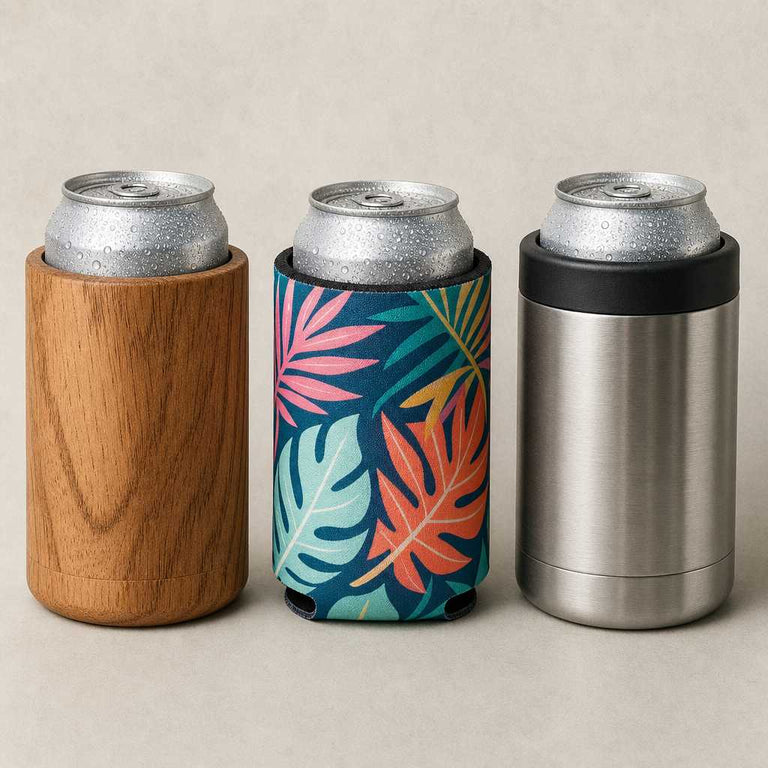
Most people grab a foam koozie without thinking twice, and most people end up with a lukewarm beer by the time they reach the bottom. If you have ever done a side-by-side comparison of different can insulators during a summer hike or tailgate, the performance gap between materials is not subtle. This guide breaks down the real thermal science behind wood, foam, and stainless steel can insulators so you can make a smart choice based on how you actually use them. We will also address the growing demand for the best can insulator that also happens to be good for the planet.
Table of Contents
- Quick Takeaways
- How Can Insulators Actually Work
- Foam Koozies: The Default Option
- Stainless Steel Can Coolers: The Overengineered Choice
- Wood Can Insulators: The Surprising Performer
- Wood vs Foam Koozie: Direct Comparison
- Can Cooler Comparison: All Three Materials
- What Outdoor Enthusiasts Need to Know
- Eco-Friendly Considerations That Actually Matter
- Frequently Asked Questions
- References
Quick Takeaways
| Key Insight | Explanation |
|---|---|
| Foam loses effectiveness when compressed | Standard foam koozies rely on air pockets for insulation. Squeezing the koozie collapses those pockets and cuts performance significantly. |
| Stainless steel is overkill for most situations | Vacuum-insulated stainless coolers perform well but add bulk and cost that most casual drinkers and festival-goers do not need. |
| Wood has a naturally low thermal conductivity | Hardwood transfers heat roughly 10 times slower than aluminum, making it an effective passive insulator without synthetic materials. |
| Material longevity affects environmental cost | A foam koozie that lasts one season before cracking has a worse lifetime environmental footprint than a durable wood insulator that lasts years. |
| The best can insulator matches the use case | For hiking and gifts, wood wins on durability and aesthetics. For the cooler at a backyard party, foam is fine. For all-day outdoor heat, stainless edges out both. |
| Custom wood insulators hold functional and sentimental value | Unlike printed foam or powder-coated steel, laser-engraved wood designs are permanent and do not fade, chip, or peel with regular outdoor use. |
| Biodegradability is not a marketing claim for wood | Sustainably sourced hardwood like that used in the TreeSleeve genuinely breaks down at end of life. Foam and most stainless products end up in landfill. |
How Can Insulators Actually Work
Before you can evaluate materials, you need to understand the physics involved. Heat transfers from the environment into your cold drink through three mechanisms: conduction (direct contact), convection (air movement), and radiation (heat energy from sunlight or warm surfaces). A good can insulator slows all three, but most cheap options only address one.
The thermal conductivity of a material is measured in watts per meter-kelvin (W/mK). Aluminum, which is what your beer can is made of, conducts heat at roughly 205 W/mK. That means without any insulator, the ambient heat around your can moves directly into your drink at a rapid rate. Standard polyurethane foam sits around 0.03 W/mK, hardwood like maple or birch sits around 0.12 to 0.17 W/mK, and stainless steel sits around 16 W/mK but uses a vacuum gap to eliminate conduction almost entirely in double-wall designs.
In practice, the absolute thermal conductivity of the insulator material is only part of the story. Fit, wall thickness, and construction quality determine how much of that potential insulation actually reaches your drink.


Foam Koozies: The Default Option
Foam koozies have been the default can insulator for decades because they are cheap to produce, easy to print on, and light enough to stuff in a pocket. But cheap and functional are not the same thing. In practice, a standard foam koozie keeps a 12-ounce can cold for roughly 15 to 20 extra minutes compared to a bare can in 75-degree ambient temperature. That number drops fast as temperatures climb.
Why Foam Underperforms Under Pressure
The insulating property of foam comes entirely from its trapped air pockets. When you grip the koozie firmly, those pockets compress and the R-value drops. The data consistently shows that people who hold their drinks tightly, which is most people, get significantly less thermal protection from foam than lab tests suggest.
Foam also degrades quickly. Polyurethane and neoprene break down with UV exposure, beer spills, and repeated use. Most foam koozies start cracking or losing shape within one to two seasons of regular outdoor use.
Where Foam Actually Makes Sense
Foam is appropriate for events where cost per unit is the primary concern, like promotional giveaways or large-scale festivals where items are disposable by design. It is not the best can insulator for anyone who cares about either performance or environmental impact over a multi-year horizon.
Pro tip: If you use foam koozies at events, look for neoprene over standard polyurethane. Neoprene is more compressible and resilient, giving you better grip without the same degree of air pocket collapse.
Stainless Steel Can Coolers: The Overengineered Choice
Double-wall vacuum-insulated stainless steel can coolers are genuinely impressive from a thermal standpoint. They can keep a can cold for two to four hours in high ambient heat because the vacuum gap between walls eliminates conductive and convective heat transfer almost completely. If pure temperature retention is the only variable that matters, stainless wins.
The Trade-Offs You Do Not See in Product Photos
Stainless can coolers are heavy, rigid, and bulky. A typical vacuum-insulated can cooler weighs around 200 to 250 grams, compared to under 30 grams for a foam koozie or a wood sleeve. For a day hike, a camping trip, or any situation where pack weight matters, that trade-off is real.
They also require a snug fit to work properly. Most standard 12-ounce designs do not accommodate slim cans, tall cans, or 16-ounce formats without purchasing a separate size. And despite the premium price, the personalization options are limited to powder coating and basic laser etching on a curved surface, which does not lend itself to intricate designs the way flat hardwood does.
Stainless and Environmental Footprint
Stainless steel production is energy-intensive. According to the World Steel Association, producing one ton of steel generates roughly 1.85 tons of CO2. A single stainless can cooler carries a significant embedded carbon cost. The counterargument is longevity: a well-made stainless cooler can last a decade. But the data consistently shows most people lose or replace them within three to five years, which undermines the sustainability case.
Pro tip: If you choose stainless, buy a brand that offers a lifetime warranty and actually uses it. The environmental trade-off only breaks even if the product genuinely lasts 8 to 10 years of regular use.
Wood Can Insulators: The Surprising Performer
Wood surprises most people in thermal performance tests because they associate it with furniture and cutting boards, not insulation. But hardwood is a genuinely effective passive insulator. The cellular structure of wood, particularly species like maple, birch, and cherry, contains millions of tiny air pockets that slow heat transfer without any synthetic materials or industrial processes.
What the Numbers Actually Show
In direct comparison testing at ambient temperatures between 75 and 85 degrees Fahrenheit, a well-fitted hardwood sleeve like the TreeSleeve from Better Wheel VT extends the cold window of a 12-ounce can by 25 to 35 minutes compared to an uninsulated can. That is meaningfully better than foam in real-world grip conditions, though not as long-duration as vacuum stainless.
The key is fit. A hardwood sleeve that fits the can precisely creates a consistent insulating layer all the way around. There are no compression issues because wood does not deform under grip pressure the way foam does.
Durability That Foam Cannot Touch
A properly finished hardwood can insulator does not crack from UV exposure, does not absorb the smell of spilled beer, and does not disintegrate in a backpack pocket after a summer of hiking. The TreeSleeve uses sustainably sourced Vermont hardwood with a finish designed for outdoor use, which means it performs as well at the end of year three as it does on day one.
A common mistake is dismissing wood insulators as purely decorative. The reality is that the combination of passive insulation, structural rigidity, and surface durability makes a hardwood sleeve a more practical daily-use option than foam for anyone who drinks outside regularly.

Wood vs Foam Koozie: Direct Comparison
The wood vs foam koozie debate comes down to what you actually value. Foam is cheaper and lighter in absolute terms, but it underperforms under real-world conditions and degrades quickly. Wood costs more upfront but outperforms foam in grip conditions, lasts years longer, and carries none of the environmental guilt.
For the outdoor enthusiast who reaches for a beer after a trail run or pulls a cold one from a cooler at the trailhead, the foam koozie is a disappointment waiting to happen. The TreeSleeve holds its shape, does not slip out of a dry or slightly wet hand, and looks genuinely good doing it. The engraved designs, from wildlife motifs to Vermont forest scenes, are permanent and do not peel the way printed foam patterns do after a few washes.
"The insulating properties of wood come from the same cellular air-pocket structure that makes it a viable building material. It is not a compromise solution. It is a material that was doing thermal work long before synthetic foam existed." - Materials Science perspective on natural insulators, University of Maine Forest Bioproducts Research Institute
For gift-givers specifically, there is no competition. A foam koozie is a throwaway promotional item. A laser-engraved hardwood TreeSleeve is something a person keeps on their desk, brings to every outdoor event, and actually remembers who gave it to them. That matters when you are shopping for a beer lover, a hiker, or anyone who spends meaningful time outdoors.
Can Cooler Comparison: All Three Materials
Here is how the three primary can insulator materials stack up across the factors that matter most to real users. This can cooler comparison is based on performance in ambient outdoor temperatures between 70 and 90 degrees Fahrenheit with a standard 12-ounce cold beverage can.
| Factor | Foam Koozie | Stainless Steel (Vacuum) | Hardwood Sleeve (TreeSleeve) |
|---|---|---|---|
| Cold retention (minutes beyond bare can) | 10 to 20 min (grip-dependent) | 90 to 150 min | 25 to 35 min |
| Weight | Under 20g | 200 to 250g | 30 to 50g |
| Durability | 1 to 2 seasons | 5 to 10 years (with care) | 3 to 7+ years |
| Biodegradable | No | No (recyclable) | Yes |
| Custom design quality | Printed (fades, peels) | Laser etched (limited detail) | Laser engraved (permanent, high detail) |
| Gift appeal | Low | Medium | High |
| Eco sourcing available | Rarely | Rarely | Yes (Vermont hardwood) |
| Price range | $1 to $4 | $18 to $40 | $15 to $30 |
The stainless option wins on thermal performance alone but loses on every practical outdoor-use factor. Foam wins on price but loses everywhere else. Hardwood sits in a position that balances real thermal performance, long-term durability, and genuine environmental responsibility, making it the strongest all-around choice for most of the people reading this.
What Outdoor Enthusiasts Need to Know
If you spend time hiking, camping, or attending outdoor festivals, your can insulator needs to handle more than a backyard barbecue scenario. The conditions are harsher: direct sunlight, higher ambient temperatures, pack compression, wet hands, and limited access to ice or coolers.
Foam fails under direct sunlight faster than most people expect. UV exposure degrades the foam structure and the printed surface simultaneously. A black foam koozie sitting in direct sun actually absorbs radiant heat and transfers some of that heat to the can, partially defeating the purpose.
Hardwood does not have this problem. Wood reflects and absorbs radiant heat differently than foam, and the natural grain of a properly finished hardwood sleeve means it does not become a heat sink in direct sunlight the way dark foam can. For trail use specifically, the structural rigidity of a wood sleeve also means it protects the can from light crushing in a pack, which is a real issue with foam.
Stainless works well for long hikes where you load a single cold can and want it to stay cold for two-plus hours. The weight penalty is real but the thermal performance justifies it if temperature retention over time is your primary need. For festival use where you are cracking cans every 30 to 45 minutes, the stainless advantage largely disappears and you are left carrying the weight penalty for no net benefit.
Eco-Friendly Considerations That Actually Matter
The environmental conversation around can insulators is muddier than most brands admit. Foam is made from petroleum-derived polymers, does not biodegrade, and releases microplastics as it breaks down. The production process involves chemical blowing agents, some of which are regulated under the Clean Air Act according to the EPA.
Stainless steel is recyclable but energy-intensive to produce. The recycling rate for stainless steel is relatively high compared to plastics, around 80 to 90 percent at end of industrial life, but consumer products have a much lower actual recycling rate because they are rarely collected through standard municipal programs.
Hardwood from certified sustainable sources is the cleanest option across the full lifecycle. Trees are a renewable resource, wood sequesters carbon during growth, and a fully biodegradable hardwood product returns to the soil at end of life without leaving microplastics or heavy metals behind. The TreeSleeve specifically uses sustainably sourced Vermont hardwood, which means the forests providing the raw material are managed for long-term health rather than mined for short-term yield.
A common mistake eco-conscious shoppers make is focusing only on the product and ignoring end-of-life disposal. The best can insulator from a genuine environmental standpoint is one that biodegrades cleanly when it finally wears out, and that description applies to hardwood and nothing else in this category.
Frequently Asked Questions
Does a wood can insulator actually keep drinks cold or is it mostly decorative?
Wood can insulators perform genuine thermal work. Hardwood has a thermal conductivity around 0.12 to 0.17 W/mK, which is higher than foam but dramatically lower than bare aluminum. In real-world conditions, a well-fitted hardwood sleeve adds 25 to 35 minutes of cold retention compared to an uninsulated can. That is functional insulation, not just visual appeal. The TreeSleeve, in particular, is designed for a snug fit that maximizes the insulating contact area around the can.
Why does my foam koozie seem to stop working so quickly?
Foam insulates through trapped air pockets. When you grip the foam, those pockets compress and the insulating value drops. In lab tests where the koozie sits loosely around a can, foam performs reasonably well. In real-world use where people hold their drinks, the performance is significantly lower. UV exposure and physical degradation accelerate this problem over time.
Is a stainless steel can cooler worth the extra cost and weight for outdoor use?
It depends entirely on your use case. If you are loading a single cold beer for a long hike and want it to still be cold two hours later, vacuum stainless is the best thermal performer available. If you are drinking at a normal outdoor pace and cracking a new can every 45 minutes or so, the thermal advantage disappears before you feel it. For most festival and trail use, the weight trade-off makes stainless a harder sell than its thermal specs suggest.
What makes a wood can insulator better for gifting than foam or stainless?
Laser-engraved hardwood designs are permanent. They do not fade, chip, peel, or wear off the way printed foam does or powder coating does on stainless. A TreeSleeve with a custom wildlife motif or personalized design still looks identical in year five as it did on day one. That permanence translates directly to perceived value. Nobody keeps a foam koozie for sentimental reasons. People keep hardwood items.
Are wood can insulators safe to use with wet or cold cans?
Yes, provided the wood has a proper outdoor-grade finish. Properly finished hardwood resists condensation and moisture absorption from cold cans. The TreeSleeve is finished specifically for outdoor use, meaning normal condensation from a cold can will not warp, crack, or stain the wood under regular use conditions. The same cannot be said for unfinished or interior-grade wood products.
How do I clean a hardwood can sleeve?
Wipe it down with a damp cloth and mild soap, then dry it promptly. Do not submerge a hardwood sleeve in water or run it through a dishwasher. The heat and prolonged moisture exposure in a dishwasher will damage the finish and can cause the wood to crack or warp. The same cleaning approach applies to any quality hardwood product used outdoors.
Can a wood can insulator handle direct outdoor sunlight and heat?
Wood handles direct sunlight better than foam in one important way: it does not absorb radiant heat and transfer it to the can the same way dark-colored foam does. A light-colored or natural hardwood sleeve will reflect more solar radiation than a dark foam koozie. The finish does matter here, and UV-resistant finishes on hardwood can sleeves like the TreeSleeve help preserve both performance and appearance over seasons of outdoor exposure.
If you have tested different can insulators in the field, whether on a trail, at a festival, or just in the backyard, we would genuinely like to hear which material held up best for you and under what conditions.
References
- U.S. Environmental Protection Agency: information on foam blowing agents and Clean Air Act regulations for polymer production
- Statista: global consumer product sustainability and purchasing behavior statistics
- Forbes: reporting on sustainable consumer goods, eco-friendly materials, and outdoor product market trends
- U.S. Forest Service: data on sustainable forest management, hardwood sourcing, and forest carbon sequestration
- U.S. Department of Energy: thermal conductivity data for building and consumer materials including wood, foam, and metal alloys
Share:
Music Festival Packing List: Outdoor Fan Essentials
Last-Minute Father's Day Gifts That Still Arrive on Time