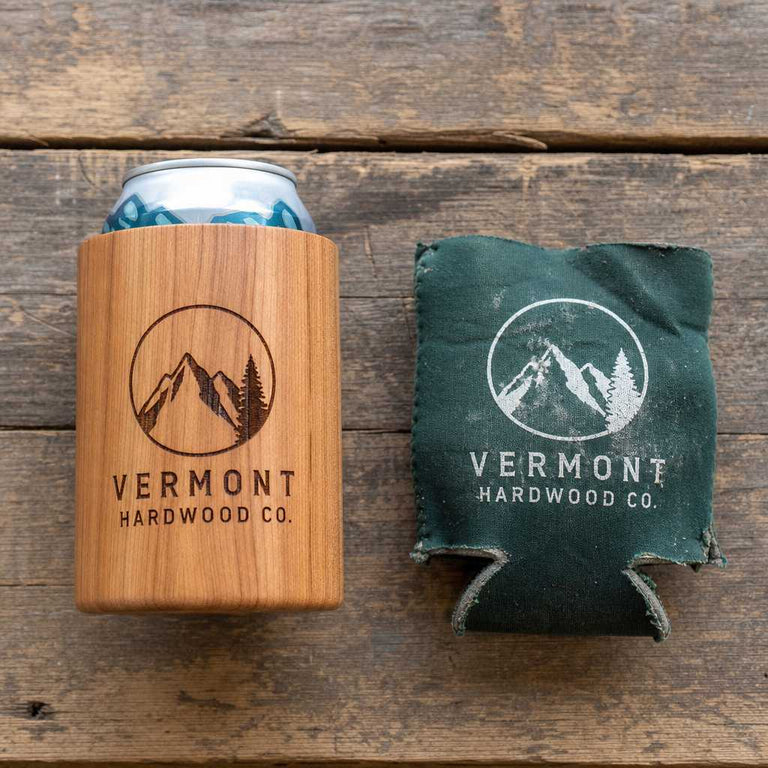
Every year, Americans toss roughly 50 billion plastic items that could have been replaced with something better. The foam and plastic koozies stuffed into junk drawers and festival swag bags are a small but real part of that problem. When you stack a wooden can insulator vs plastic koozie side by side, the comparison is not even close on durability, insulation performance, or environmental impact. TreeSleeve™ by Better Wheel VT makes that case concrete: a sustainably sourced Vermont hardwood can holder that does the job better and disappears cleanly at the end of its life.
Table of Contents
- Quick Takeaways
- Why Plastic Koozies Fall Short
- What Makes Vermont Hardwood Different
- Insulation Performance Compared
- Biodegradable Can Sleeve: The Environmental Math
- Sustainable Drinkware Gifts: Why the Gift Market Is Shifting
- Comparison Table: TreeSleeve™ vs. Plastic Koozie vs. Neoprene Sleeve
- Who Actually Buys a Vermont Hardwood Can Holder
- Frequently Asked Questions
- References
Quick Takeaways
| Key Insight | Explanation |
|---|---|
| Hardwood outperforms foam on longevity | A TreeSleeve™ made from dense Vermont hardwood will not compress, tear, or absorb odors the way a foam koozie does after a few uses. |
| Plastic koozies are not recyclable in most curbside programs | Neoprene and foam koozies are composite materials that most municipal recycling facilities reject, meaning they end up in landfill by default. |
| Wood is a genuine natural insulator | Hardwood has a thermal conductivity around 0.17 W/m·K, making it a measurably effective barrier against heat transfer from your hand to the can. |
| Biodegradable can sleeves carry real end-of-life value | When a TreeSleeve™ eventually reaches the end of its life, it composts naturally. A plastic koozie persists in the environment for 400-plus years. |
| Sustainable drinkware gifts command premium perceived value | According to Statista, 60 percent of consumers under 40 say they prefer gifts that reflect sustainable values, which directly benefits products like TreeSleeve™. |
| Vermont hardwood sourcing adds provenance that plastic cannot match | Sustainably harvested hardwood from Vermont forests carries a traceable, local story that resonates with outdoor enthusiasts and eco-conscious buyers alike. |
| Custom designs hold value; printed koozies fade and peel | Laser-engraved or branded designs on hardwood do not fade, crack, or wash off, making TreeSleeve™ a gift that stays legible and attractive for years. |
Why Plastic Koozies Fall Short
The plastic koozie has been a default promotional giveaway for decades, mostly because it is cheap to produce in volume. That low cost, however, masks a set of real problems that accumulate over time for both the user and the environment.
In practice, foam and neoprene koozies deteriorate faster than most people expect. The foam compresses after repeated use, losing its insulating air pockets and becoming little more than a thin sleeve. Neoprene holds its shape longer but traps moisture and develops odors, particularly when used outdoors at festivals or camping trips where drying time is limited.
The bigger problem is disposal. Foam koozies are typically made from polyurethane or ethylene-vinyl acetate (EVA). Neither material is accepted in standard curbside recycling programs. Neoprene is even more complicated, a synthetic rubber that has no practical recycling pathway for consumers. According to the U.S. Environmental Protection Agency, only 8.7 percent of plastic waste in the United States was recycled as of the most recent data. The rest goes to landfill or worse.
A common mistake among buyers is assuming that a koozie labeled as low-cost means low-impact. The actual cost, measured in material lifespan and disposal burden, is considerably higher than the sticker price suggests.
Pro tip: Before buying promotional drinkware, ask the supplier directly what material the sleeve is made from and whether it is accepted by municipal recycling in your area. Most plastic koozie vendors cannot give a clean answer to either question.

What Makes Vermont Hardwood Different
Not all wood products are created equal, and that distinction matters when you are evaluating a Vermont hardwood can holder against generic alternatives. The hardwood used in TreeSleeve™ comes from Vermont forests managed under sustainable harvesting practices, which means the trees are selectively cut, the forest canopy is maintained, and the regional ecosystem stays intact.
Sustainably Sourced Does Not Mean a Marketing Label
Sustainability claims on consumer products are frequently vague, but in the case of Vermont hardwood, the sourcing story is specific and verifiable. Vermont's forests cover approximately 4.5 million acres, and the state has one of the strongest forest management frameworks in the northeastern United States. Wood harvested here comes from a system designed to regenerate, not deplete.
This is not the same as buying a bamboo product from an overseas supplier where the supply chain is difficult to audit. When Better Wheel VT says the hardwood is sustainably sourced from Vermont forests, that claim connects to a regional forestry culture with a long track record.
Density and Grain Quality Affect Function, Not Just Appearance
Vermont hardwoods like maple and cherry are dense, tight-grained species. That density is precisely what makes them effective insulators. A tight grain also means the wood resists moisture absorption better than softer woods, which is directly relevant for a product that sits in your hand next to a cold, condensing can.
The grain patterns and natural color variation in Vermont hardwood also mean that every TreeSleeve™ looks slightly different. That is a feature, not a flaw. It gives the product a handcrafted character that no injection-molded koozie can replicate.
"Consumers increasingly want products that tell a story about where they came from and who made them. Provenance is a purchase driver, not just a marketing detail." - Harvard Business Review, on the premium goods market
Insulation Performance Compared
The primary functional job of any can sleeve is to slow heat transfer. A cold beer held in a warm hand without protection reaches drinking temperature in roughly 4 to 6 minutes depending on ambient conditions. That is the baseline problem every koozie or sleeve is trying to solve.
Foam koozies work by trapping air in their cell structure, and that trapped air acts as an insulating barrier. The problem is that compressed or aged foam loses those air pockets. A brand-new foam koozie performs reasonably well. One that has been used a dozen times performs noticeably worse because the foam cells have collapsed.
Wood does not degrade this way. Hardwood maintains its thermal properties across its entire useful life. The thermal conductivity of hardwood sits at approximately 0.17 W/m·K, compared to roughly 0.04 W/m·K for fresh foam. Foam does start with a lower conductivity number, but only when new and only when the cells are intact. In the field, and over time, hardwood is the more reliable performer.
There is also the matter of grip and handling. A TreeSleeve™ gives the hand a dry, stable grip even when the can is sweating heavily. Foam becomes slippery when wet. Neoprene has better wet grip than foam but still compresses under hand pressure, reducing its insulating thickness at exactly the moment it is being used.
Pro tip: If you are choosing a can insulator for outdoor conditions like camping, trail hikes, or festivals, prioritize materials that maintain their shape under repeated use and wet conditions. Wood wins that comparison clearly.

Biodegradable Can Sleeve: The Environmental Math
The term biodegradable can sleeve is easy to say and harder to substantiate. TreeSleeve™ earns that label in a straightforward way: it is made from solid hardwood with no synthetic binders, coatings, or laminate layers. When it eventually reaches the end of its usable life, it breaks down through natural decomposition processes in months to a few years, depending on conditions.
Compare that to a standard foam koozie. Polyurethane foam can persist in a landfill environment for an estimated 500 years. Neoprene is similarly durable in ways that are harmful rather than useful. These materials do not break down into soil nutrients. They fragment into microplastics, which the National Institutes of Health has linked to a growing range of biological concerns in both wildlife and humans.
The carbon accounting also favors wood. Trees sequester carbon during their growth. When a sustainably managed Vermont hardwood tree is harvested and turned into a TreeSleeve™, that sequestered carbon remains locked in the wood product for its entire useful life. A petroleum-based foam koozie, by contrast, requires fossil fuel extraction and energy-intensive manufacturing without any carbon sequestration offset.
The data consistently shows that consumers underestimate how long plastic composite products persist in the environment. According to the EPA, the average American generates over 4.4 pounds of waste per day, and a meaningful share of that is composite materials with no viable recycling pathway. Choosing a genuinely biodegradable product is one direct way to break that pattern.
Sustainable Drinkware Gifts: Why the Gift Market Is Shifting
The gift market for outdoor and adventure-oriented buyers is not the same market it was five years ago. Buyers in this segment are increasingly skeptical of mass-produced, plastic-heavy products that will end up in a landfill within a year. They want something that reflects their values as much as their recipient's interests.
Sustainable drinkware gifts have moved from a niche category to a mainstream expectation. According to Statista's consumer sentiment data, sustainability as a purchase factor has grown consistently year over year among adults aged 25 to 44, which is precisely the demographic that shops for outdoor enthusiasts and beer lovers.
Why TreeSleeve™ Outperforms Generic Eco-Gifts in This Context
A lot of products claim an eco-friendly angle but deliver it superficially, a bamboo toothbrush packaged in layers of plastic, for example, or a reusable bag made from a synthetic blend. TreeSleeve™ avoids that contradiction. The material is genuinely natural, the sourcing is regional and traceable, and the product works well at its actual function, keeping drinks cold.
That combination matters to gift-givers because the recipient will actually use it. A beautiful object that fails at its job ends up in a closet. A functional object that also carries a genuine sustainability story gets used at the campfire, on the trail, and at the tailgate, which extends the visibility and perceived value of the gift.
Custom Options Elevate the Gift Experience
Better Wheel VT offers custom designs on TreeSleeve™, including outdoor themes, wildlife motifs, and personalized options. Engraving on hardwood holds crisp detail permanently, unlike printed designs on foam that fade or crack after a season of outdoor use. For gift-givers looking for something specific and lasting, that permanence is a real selling point.
Comparison Table: TreeSleeve™ vs. Plastic Koozie vs. Neoprene Sleeve
| Feature | TreeSleeve™ (Vermont Hardwood) | Standard Plastic/Foam Koozie | Neoprene Sleeve |
|---|---|---|---|
| Material origin | Sustainably harvested Vermont hardwood | Petroleum-derived polyurethane or EVA foam | Synthetic rubber (petroleum-derived) |
| Insulation longevity | Consistent over full product life | Degrades as foam cells compress | Moderate, stable but compressible under grip |
| End-of-life disposal | Fully biodegradable, composts naturally | Landfill only, persists 400-500 years | Landfill only, no consumer recycling pathway |
| Custom design durability | Laser engraving is permanent | Printed designs fade and peel | Screen prints wear off with use |
| Wet grip performance | Dry, stable grip even when can sweats | Slippery when wet | Better wet grip than foam, still compresses |
| Gift appeal | High, unique material with provenance story | Low, perceived as generic promotional item | Moderate, functional but undifferentiated |
| Price point | Premium | Low | Low to mid |
Who Actually Buys a Vermont Hardwood Can Holder
The buyer profile for a Vermont hardwood can holder like TreeSleeve™ is specific, and understanding it explains why the product is not trying to compete on price with foam koozies. It is competing on a completely different set of values.
Outdoor enthusiasts who hike, camp, or attend nature-focused events are the core audience. This group already purchases gear and products with an eye toward durability and environmental responsibility. They are accustomed to paying more for things that work better and last longer. A hardwood can sleeve fits naturally into that purchasing mindset.
Eco-conscious gift shoppers are the second major segment. These are buyers looking for presents for the beer lover, the festival regular, or the person who already owns everything practical they need. The gift has to be distinctive and communicate something about the giver's values as well as the recipient's interests. A TreeSleeve™ with a wildlife engraving checks both boxes in a way that a foam koozie never could.
In practice, customers who discover TreeSleeve™ through outdoor and eco-focused channels tend to share the product socially at higher rates than buyers of commodity drinkware accessories. The product is visually distinctive enough to prompt conversation, which is the organic behavior that builds brand awareness in this market segment.

Frequently Asked Questions
Is a wooden can insulator as effective as foam at keeping drinks cold?
Yes, and in many conditions it performs more reliably over time. Hardwood has a stable thermal conductivity that does not degrade with use, while foam loses its insulating air cells as it compresses. A TreeSleeve™ made from Vermont hardwood holds its thermal performance across its entire usable life, which is not something a foam koozie can claim after heavy use.
Is TreeSleeve™ actually biodegradable, or is that just a marketing claim?
TreeSleeve™ is made from solid hardwood with no synthetic coatings, laminates, or plastic binders, which means it is genuinely biodegradable. When composted or left in natural conditions, it breaks down through standard organic decomposition. This is not the case for foam or neoprene koozies, which persist in landfill environments for centuries and fragment into microplastics rather than breaking down into harmless organic material.
How is the hardwood in TreeSleeve™ sustainably sourced?
Better Wheel VT sources hardwood from Vermont forests managed under sustainable harvesting practices. Selective cutting methods are used to maintain forest canopy and biodiversity, and Vermont's regional forestry framework is among the most robust in the northeastern United States. This means the sourcing claim is tied to a specific, auditable regional practice rather than a vague supply chain.
Can I get a custom design on a TreeSleeve™ for a gift?
Yes. Better Wheel VT offers custom design options including outdoor themes, wildlife motifs, and personalized engravings. Designs are engraved directly into the hardwood, which means they are permanent and will not fade, crack, or wash off over time. This makes customized TreeSleeve™ products a significantly more durable gift than a printed foam koozie, where custom artwork typically begins fading within a season of regular use.
How does the price of a TreeSleeve™ compare to a standard plastic koozie?
TreeSleeve™ is a premium product and is priced accordingly. A standard foam koozie is cheaper upfront because it is made from low-cost synthetic materials at industrial scale. However, when you factor in the usable lifespan of each product, the environmental disposal cost of the plastic version, and the gift value of a handcrafted hardwood sleeve with permanent engraving, the TreeSleeve™ delivers considerably more value per dollar over its lifetime.
Is a wooden can sleeve suitable for outdoor use in wet conditions?
Yes. Dense Vermont hardwood species like maple have a naturally tight grain that resists moisture absorption better than soft woods. In wet outdoor conditions, a TreeSleeve™ maintains its grip and insulating performance. Foam koozies become slippery and lose structural integrity when wet, and neoprene, while better in wet conditions than foam, compresses under hand pressure in ways that reduce its effective insulating thickness.
Have you made the switch from plastic koozies to a hardwood can sleeve, or are you still on the fence? Share your experience or questions below, we would like to hear what actually drove your decision.
References
- U.S. Environmental Protection Agency: national data on plastic waste generation and recycling rates in the United States
- Statista: consumer survey data on sustainability as a purchase driver among adults aged 25 to 44
- National Institutes of Health: research on microplastic fragmentation and biological impact in wildlife and humans
- Forbes: reporting on the premium goods market and the role of product provenance in consumer purchasing decisions
- U.S. Forest Service: forest management data and sustainable harvesting guidelines for northeastern hardwood forests
Share:
10 Outdoor Adventures Better With a TreeSleeve™
Hardwood Can Insulators Are Replacing Neoprene Koozies