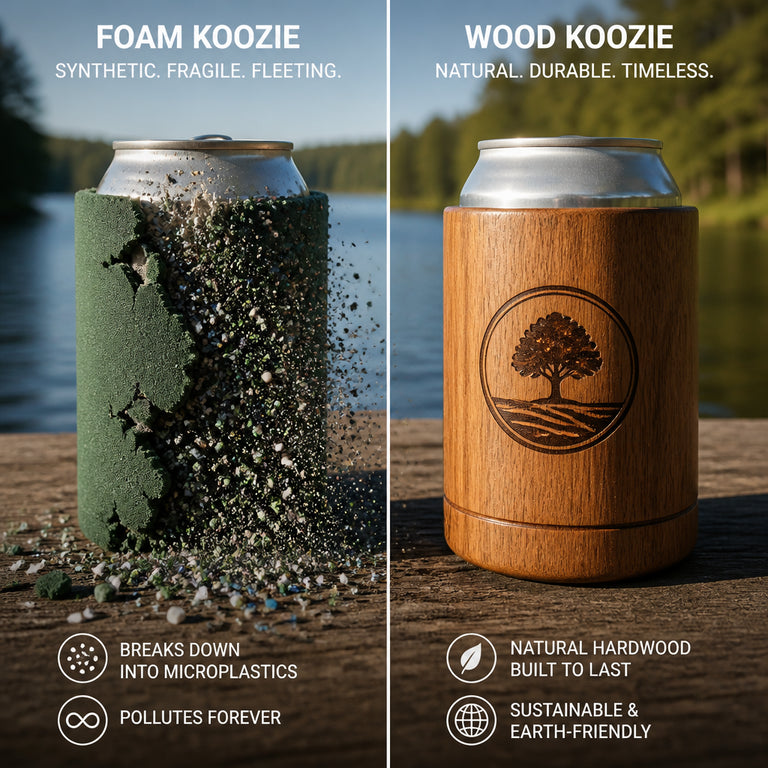
Foam koozies have been a summer staple for decades, but here is the uncomfortable truth: most of them end up in landfills where they will outlast the people who used them by hundreds of years. The average foam koozie is made from expanded polystyrene, a material the EPA classifies as a persistent environmental pollutant. If you are searching for a biodegradable koozie alternative that actually works, holds up at a tailgate, and does not leave a plastic footprint behind, this article lays out exactly why the switch matters and what it looks like in practice.
Table of Contents
- Foam Koozies Are an Environmental Liability
- Quick Takeaways
- Reason 1: Polystyrene Does Not Biodegrade
- Reason 2: Foam Sheds Microplastics into Waterways
- Reason 3: Biodegradable Alternatives Actually Insulate Better
- Reason 4: Hardwood Insulators Are Built for Outdoor Use
- Reason 5: Sustainable Summer Gear Signals Your Values
- Reason 6: Custom Wood Koozies Make Gifts That People Keep
- Reason 7: Eco-Friendly Can Coolers Support Local Economies
- Reason 8: Foam Koozie Alternatives Perform at Festivals and Events
- Comparison Table: Foam vs. Neoprene vs. Hardwood Can Insulators
- Frequently Asked Questions
- References
Foam Koozies Are an Environmental Liability
Quick Takeaways
| Key Insight | Explanation |
|---|---|
| Polystyrene persists for 500+ years | Standard foam koozies are made from expanded polystyrene that never fully biodegrades in landfill conditions. |
| Hardwood insulators are genuinely biodegradable | Products like the TreeSleeve from Better Wheel VT are crafted from sustainably sourced Vermont hardwood and break down naturally at end of life. |
| Insulation performance is comparable or better | Dense wood grain provides natural thermal resistance that keeps canned beverages cold for comparable durations to foam. |
| Eco-conscious consumers are the fastest-growing buyer segment | According to Nielsen, 73% of global consumers say they would definitely or probably change their consumption habits to reduce environmental impact. |
| Biodegradable koozies double as meaningful gifts | Engraved or custom-designed wood can insulators have lasting sentimental value that disposable foam never achieves. |
| Foam sheds microplastics at outdoor events | Heat and UV exposure cause polystyrene to fragment, releasing microplastic particles directly into natural environments. |
| Sustainably sourced hardwood supports forest health | Vermont hardwood operations that follow sustainable harvesting guidelines actively contribute to long-term forest regeneration. |
Before jumping into each reason, it helps to understand the scale of the problem. The United States produces roughly 14 million tons of plastic packaging waste annually, and promotional foam products, including koozies, represent a quiet but consistent contributor to that total. Most people grab a foam koozie at a race, a festival, or a corporate event without a second thought. That is exactly the habit worth reconsidering.
Reason 1: Polystyrene Does Not Biodegrade
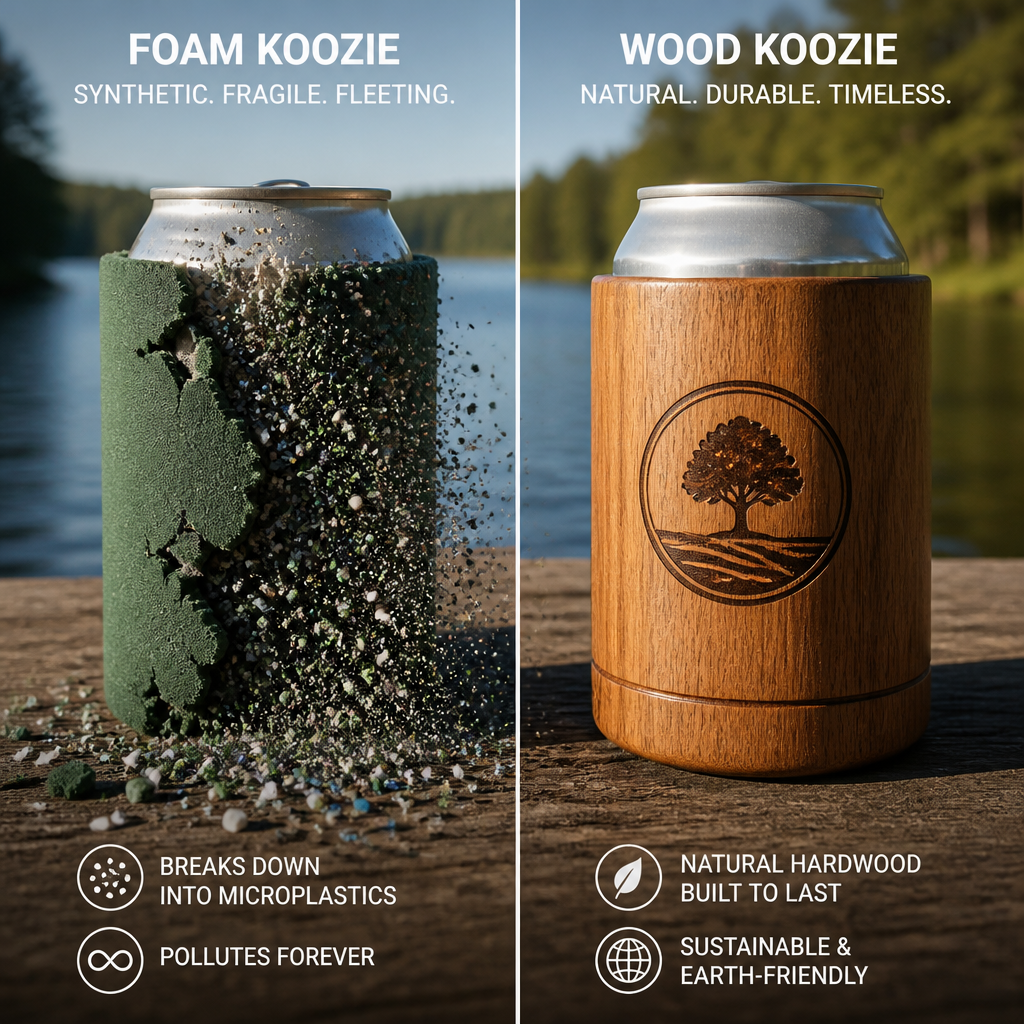
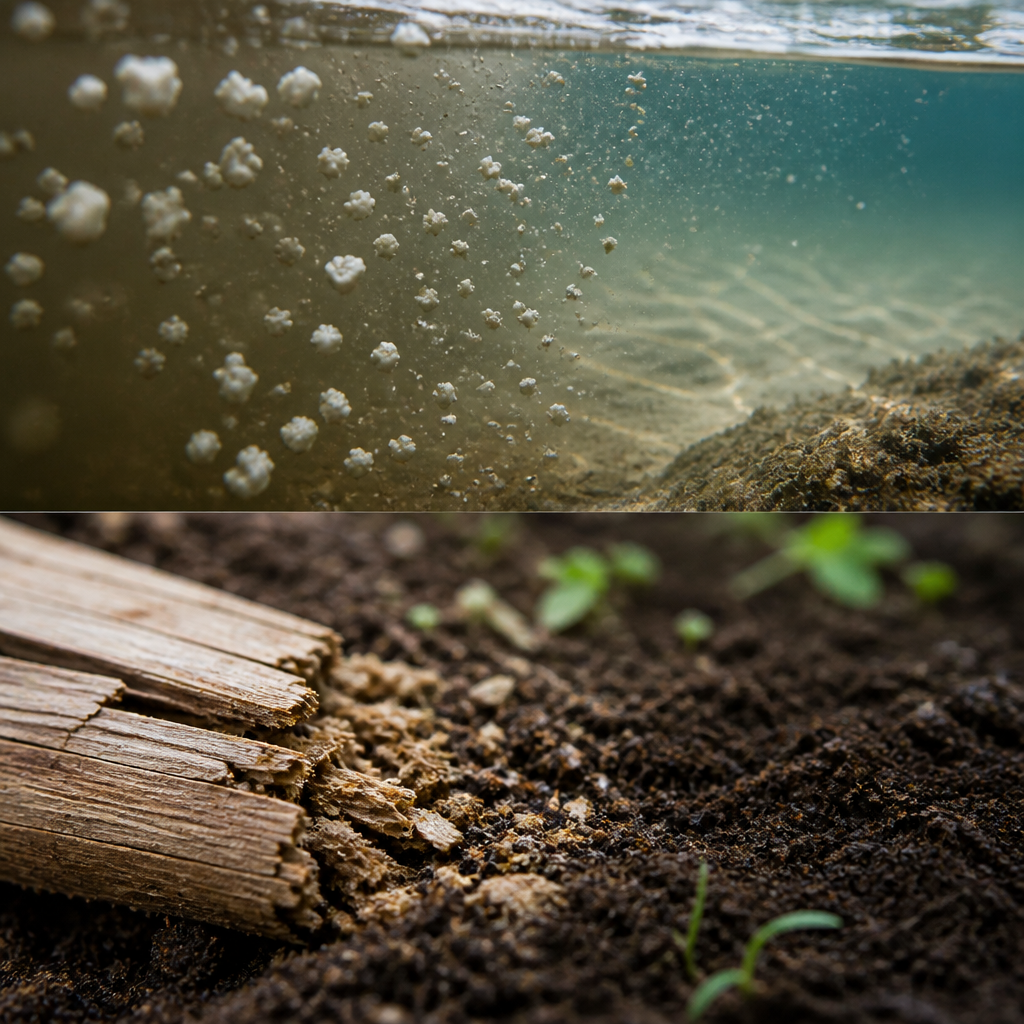
Let us be direct about what foam koozies are made of: expanded polystyrene (EPS), the same material used in disposable coffee cups and packing peanuts. According to the U.S. Environmental Protection Agency, polystyrene does not biodegrade under standard landfill conditions. Estimates for its persistence in the environment range from 500 years to effectively never.
In practice, this means every foam koozie handed out at a company picnic or summer cookout will outlast the company itself. The material photodegrades, meaning UV light breaks it into smaller and smaller particles, but it never returns to the earth as organic matter.
A biodegradable koozie alternative made from hardwood behaves completely differently. When a hardwood product reaches the end of its usable life, it can be composted, buried, or simply left in a natural environment where it will decompose within years, not centuries. That is not a minor distinction. That is the entire difference between a product that contributes to ecological health and one that undermines it.
Reason 2: Foam Sheds Microplastics into Waterways
A common mistake people make is assuming that because a foam koozie stays intact, it is not polluting anything. The reality is more insidious. Polystyrene begins shedding styrene monomer and microplastic particles when exposed to heat and UV radiation, both of which are unavoidable at outdoor summer events.
Research published in environmental science journals has confirmed that microplastics from polystyrene products are now present in freshwater systems, marine environments, and even in human blood. For outdoor enthusiasts who spend time near Vermont lakes, rivers, and trails, this is not an abstract concern. These are the same waters where people kayak, fish, and swim.
Choosing an eco-friendly can cooler made from sustainably sourced hardwood eliminates this pathway entirely. Wood does not shed synthetic particles. It does not leach chemicals into beverages when it warms up. It is an inert, natural material that has been used safely for centuries.
Pro tip: When shopping for a biodegradable koozie alternative, look specifically for products that disclose their raw material sourcing. Vague terms like "natural" or "earth-friendly" on foam products mean nothing without material certification or third-party verification.
Reason 3: Biodegradable Alternatives Actually Insulate Better
Here is where a lot of people are surprised. The assumption is that foam must be the superior insulator because that is what it has always been used for. In practice, dense hardwood provides competitive thermal performance, and in some conditions it outperforms foam.
Wood has a low thermal conductivity value, meaning it transfers heat slowly between environments. Foam achieves insulation by trapping air in its cellular structure, but that structure degrades over time and with repeated use. A foam koozie that has been through a few summers of tailgating has measurably lower insulation performance than it did when new.
Hardwood maintains its structural integrity and thermal properties across hundreds of uses. A TreeSleeve from Better Wheel VT is not a disposable product. It is designed to be used at every campfire, trail run finish, or lakeside gathering for years. That durability changes the environmental math entirely: fewer units produced, less waste generated, more value delivered per product.
"The greenest product is often the one you buy once and use forever." - A principle consistently applied in lifecycle assessment studies on consumer goods from the EPA's Sustainable Materials Management program.
Reason 4: Hardwood Insulators Are Built for Outdoor Use
Foam koozies collapse, tear, absorb odors, and stain. Anyone who has left one in a cooler bag for a summer knows what it looks like by August. The material simply was not engineered for repeated exposure to the conditions that outdoor enthusiasts routinely encounter: moisture, heat, UV light, rough handling in a pack or dry bag.
Hardwood behaves differently in all of these conditions. Vermont hardwoods like maple and birch are naturally dense and moisture-resistant. They do not absorb the smell of yesterday's IPA. They do not compress and lose their grip on a can after a few uses. They develop a character with age rather than degrading into a crumbling, discolored lump at the bottom of a gear bag.
Durability on the Trail vs. Durability at the Tailgate
The demands placed on sustainable summer gear vary by context. Hikers and trail runners need products that fit compactly, resist moisture, and stay functional after being jostled in a pack for miles. Tailgaters need something that survives a full day in a cooler, gets handed around a group, and still looks good.
Hardwood can insulators perform in both environments without modification. Their rigid form maintains can grip even when conditions change. Their natural finish does not peel, crack, or absorb condensation the way some neoprene and foam products do in high-humidity summer conditions.
Reason 5: Sustainable Summer Gear Signals Your Values
The gear people carry into the outdoors communicates something about how they relate to those spaces. Carrying single-use foam products into a national forest or onto a paddling trail sends a message that is at odds with the reason most people go outdoors in the first place.
According to Nielsen's Global Sustainability Report, 66% of consumers, and 73% of millennials specifically, are willing to pay a premium for products from companies committed to positive social and environmental impact. That number rises sharply among people who identify as outdoor enthusiasts, precisely the audience that cares most about the places they visit.
Choosing an eco-friendly can cooler made from sustainably harvested Vermont hardwood is not just a purchasing decision. It is a consistent extension of the values that drive someone to prefer a mountain trail over a strip mall, or a Vermont lake over a hotel pool. The product you carry into those spaces is part of the experience.
Pro tip: If you are buying for a group trip, wilderness retreat, or outdoor festival, consider custom-engraved hardwood can insulators as a way to give the whole group gear they will actually keep and use rather than toss after the event.
Reason 6: Custom Wood Koozies Make Gifts That People Keep
Foam koozies are given away because they are cheap to produce in bulk. Nobody keeps a foam koozie. They accumulate in a junk drawer until someone throws the whole pile out. The product has no intrinsic value beyond its momentary function, and even that function degrades quickly.
A custom hardwood can insulator is a fundamentally different gift object. The natural grain variation in Vermont hardwood means every piece is visually unique. Add an engraved wildlife motif, a mountain scene, or a personalized message, and you have a product that sits on a shelf, gets used at every outdoor gathering, and generates a conversation every time it comes out of a bag.
For eco-conscious gift shoppers, this distinction matters enormously. Giving someone a foam koozie means giving them a piece of future landfill. Giving them a TreeSleeve means giving them a functional piece of craft that aligns with their values. The Better Wheel VT lineup includes wildlife and outdoor-themed designs specifically because those motifs resonate with the people most likely to treasure the product long-term.
Reason 7: Eco-Friendly Can Coolers Support Local Economies
Most foam koozies are manufactured overseas using petroleum-based raw materials and synthetic dyes. The supply chain is opaque, the labor conditions are rarely disclosed, and the product travels thousands of miles before reaching a summer cookout in New England.
A hardwood can insulator made from Vermont forests is a fundamentally different supply chain story. Sustainably sourced hardwood supports Vermont's forestry sector, which employs thousands of people and contributes to responsible land management practices that benefit the entire region. When you choose a product like the TreeSleeve, you are putting money directly into a local manufacturing ecosystem rather than an anonymous overseas factory.
The data consistently shows that consumers increasingly factor supply chain transparency into purchasing decisions. A 2023 McKinsey report on consumer sustainability attitudes found that nearly 60% of surveyed consumers ranked supply chain traceability as a significant purchase driver for lifestyle and outdoor products. Hardwood insulators from regional producers meet that standard in a way that commodity foam never will.
Reason 8: Foam Koozie Alternatives Perform at Festivals and Events
Outdoor festivals generate enormous amounts of waste. A single two-day music or outdoor recreation festival can produce thousands of discarded foam items. Organizers and attendees who care about the event's footprint are actively looking for alternatives that hold up through a full weekend without ending up scattered across a field.
Hardwood can insulators are festival-ready in ways foam never is. They fit standard 12 oz. cans, they handle rough treatment in a backpack or a tote, and they do not disintegrate in the rain or heat. More importantly, they give festival-goers a reason to keep the item rather than discard it at the gate on the way out.
Beer lovers and craft beer enthusiasts, a core audience for products like the TreeSleeve, are also among the most engaged sustainability communities in consumer culture. The craft beer movement has deep roots in environmental stewardship, local sourcing, and small-batch production values. An eco-friendly can cooler made from local hardwood fits seamlessly into that cultural identity in a way that a generic foam product from a big-box supplier simply cannot match.
Comparison Table: Foam vs. Neoprene vs. Hardwood Can Insulators
Not all koozie alternatives are created equal. The table below compares three common can insulator types across the dimensions that matter most to outdoor enthusiasts and eco-conscious buyers.
| Feature | Foam (Polystyrene) | Neoprene | Hardwood (TreeSleeve) |
|---|---|---|---|
| Biodegradable | No, persists 500+ years | No, synthetic rubber | Yes, fully biodegradable hardwood |
| Durability | Low, degrades within one season | Medium, stretches and stains over time | High, maintains integrity for years |
| Insulation Performance | Adequate when new, degrades quickly | Good, consistent thermal barrier | Good, low thermal conductivity of dense hardwood |
| Microplastic Risk | High, sheds particles with heat and UV | Medium, synthetic material degradation | None, natural organic material |
| Gift Value | None, disposable perception | Low to medium, functional but generic | High, unique grain, custom engraving options |
| Outdoor Suitability | Low, absorbs odors and collapses under pressure | Medium, moisture-resistant but bulky | High, weather-resistant and compact |
| Supply Chain Transparency | Low, typically overseas mass production | Low to medium, varies by brand | High, Vermont-sourced and locally crafted |
Frequently Asked Questions
What makes a koozie truly biodegradable?
A truly biodegradable koozie is made from organic materials that decompose through natural biological processes without leaving synthetic residue. Hardwood meets this standard because it breaks down via microbial activity in soil or compost. Foam and neoprene do not qualify because they are petroleum-derived synthetics that fragment into microplastics rather than returning to organic matter.
Does a wooden can insulator keep drinks as cold as foam?
Yes, in practice the difference is negligible for typical use cases. Dense hardwood has low thermal conductivity, meaning it is a natural insulator that slows heat transfer from your hand to the can. Foam outperforms wood only in laboratory conditions optimized for polystyrene, but those conditions do not reflect real-world use on a hiking trail or at a summer festival where foam degrades quickly with repeated handling.
Are hardwood can insulators heavier to carry outdoors?
A hardwood TreeSleeve weighs only marginally more than a foam koozie and far less than a neoprene sleeve when wet. For backpacking contexts, ounces matter, and the weight difference is minor enough that most outdoor users do not notice it. The trade-off in durability and zero waste strongly favors the hardwood option for anyone serious about their environmental footprint on the trail.
Can I get a custom design on a biodegradable hardwood koozie?
Yes. Better Wheel VT offers custom engraving and design options on the TreeSleeve, including personalized text, wildlife motifs, and outdoor themes. Because every piece of Vermont hardwood has a unique natural grain pattern, no two custom units are identical, which makes them significantly more compelling as gifts than any foam or mass-produced neoprene alternative.
Why do foam koozies still dominate if they are so problematic?
Cost and inertia. Foam koozies are extremely cheap to produce in bulk, which makes them attractive for promotional giveaways where unit price is the primary consideration. The environmental cost is externalized and invisible at the point of purchase. As consumer awareness of microplastic pollution and landfill waste grows, and as better alternatives become more accessible and affordable, the dominance of foam is eroding. The shift is already visible in the craft beverage and outdoor recreation markets where sustainability credentials carry real commercial weight.
Where can I buy a biodegradable koozie alternative in Vermont?
Better Wheel VT manufactures and sells the TreeSleeve directly through their website at betterwheelvt.com. The product ships nationally, and the company offers both individual and bulk order options. For Vermont-based outdoor enthusiasts, purchasing locally means both faster delivery and the added benefit of supporting a regional maker using Vermont-sourced hardwood.
Have you already made the switch from foam to a biodegradable koozie alternative? Share what drove your decision and what you noticed after making the change.
References
- U.S. Environmental Protection Agency: information on polystyrene, microplastics, and sustainable materials management
- Statista: global consumer data on sustainable purchasing behavior and eco-friendly product trends
- McKinsey and Company: research on consumer sustainability attitudes and supply chain transparency in lifestyle products
- Forbes: reporting on the growth of eco-conscious consumer markets and biodegradable product categories
- National Institute of Environmental Health Sciences: research on microplastic exposure pathways and human health implications
Share:
Vermont Hardwood and Your Beer: The TreeSleeve™ Story
Best Eco-Friendly Gifts for Campers and Hikers 2024